Mr Musaab YassinOxford Men’s Health

Oxford Men’s Health

The problem you’ve been putting off usually has a straightforward answer.

A private men’s health and urology clinic led by Mr Musaab Yassin, Consultant Urological Surgeon and Andrologist. Prostate, fertility, erectile dysfunction, Peyronie’s and continence — assessed properly and explained honestly.

Mr Musaab Yassin, Consultant Urological Surgeon and Andrologist.
Musaab Yassin FRCS (Urol) · GMC 6118378
FRCS (Urol) Fellowship-trained in andrology and reconstructive urology
2023 Patients’ Choice Award Oxford University Hospitals
English & Arabic Consultations in either language
Oxford at dusk: the spire of the University Church of St Mary the Virgin, the dome of the Radcliffe Camera, and college roofs against the Oxfordshire hills.
Oxford, and an hour from Chelsea. Consulting and operating at Nuffield Health The Manor Hospital in Oxford, and at The Lister Hospital in London.

Start here

Tell me what is actually happening, in your own words.

Most men arrive knowing the symptom, not the diagnosis. Pick the line that sounds like you and it will take you to the right place.

Prostate & urinary flow “I am up three or four times every night.”

A weak stream, hesitancy, getting up to pee, or the feeling that you never quite empty. Usually a prostate pressing on the pipe — and there are now several quite different ways to fix it.

What can be done →
Male fertility “We have been trying, and the tests came back bad.”

A low count, no sperm at all, or a vasectomy you would like reversed. Half of all fertility problems are male, and most of them have never been properly investigated.

What can be done →
Peyronie’s disease “It has changed shape, and nobody will discuss it.”

A new curve, a lump you can feel, or pain with erections. Treatable at every stage — and what is appropriate depends on whether the disease is still changing or has settled.

What can be done →
Erectile dysfunction “The tablets worked, and now they don’t.”

Erections that fail, arrive unreliably, or no longer last. There is a ladder of treatment above tablets that most men are never told about — and the symptom itself is worth investigating for what it says about your arteries.

What can be done →
Continence after prostate treatment “I am still wearing pads, two years on.”

Leaking after a prostatectomy or radiotherapy is not something you have to accept, and it does not improve on its own after the first year. There is a reliable operation for it.

What can be done →
Everyday urology “The pain came out of nowhere, and they sent me home to wait.”

Colic, blood in the urine, or a stone found on a scan you had for something else. Whether it will pass is mostly a question of size — and if it will not, waiting only postpones the answer.

What can be done →

Why men choose this practice

Five things that are genuinely different here.

01

You see the consultant. Every time.

The person who assesses you is the person who operates and the person who reviews you afterwards. Nothing is delegated to a registrar or a nurse-led clinic, and you have one point of contact throughout.

02

The trade-offs are published, in writing.

Every operation costs you something. This practice publishes long, referenced appraisals of each one — including the unflattering numbers — so you can read the case against a treatment before you agree to it.

03

Four narrow fields, not all of urology.

Prostate obstruction at any gland size; male fertility microsurgery; andrology, meaning Peyronie’s disease and erectile dysfunction; and reconstruction after prostate cancer treatment. In each of these, the result depends on technique more than on anything else. The everyday urology around them — stones first among it — is done here too, but it is not what the practice is built on.

04

Discreet, and used to awkward conversations.

Every subject on this page is one men delay for years. You do not need a referral to book privately, correspondence is confidential, and nothing about the consultation assumes you have discussed it with anyone.

05

A stone is treated as a question, not just an object.

Removing a stone is the easy half. The men who are back within two years are almost always the ones nobody asked why they made it. Here the first stone gets analysed and the second gets a metabolic work-up, so that the plan covers the next one as well as the one that is there now.

What I treat

Five areas, in depth rather than in breadth.

Each area has a page of its own, carrying the guides, the evidence and the questions that belong to it and nothing from any other. What is here is the short version: the question, the honest trade-off, and the way in. The everyday urology around the five — stones first among it — has a block of its own at the end.

An enlarged prostate, and a night you sleep through

By sixty, most men have some prostate enlargement. The question is never whether you have it — it is whether it is obstructing you, and which of six treatments fits your gland and your priorities.

The honest trade-off HoLEP removes the most tissue and has ten-year durability behind it, but usually costs forward ejaculation. Rezūm and UroLift protect sexual function and work faster or more gently, at some cost in completeness and a greater chance of needing something further. Aquablation sits between them. No option is best at both.

Written and reviewed by Mr Musaab Yassin, Consultant Urological Surgeon & Andrologist. FRCS (Urol) · GMC 6118378 ·

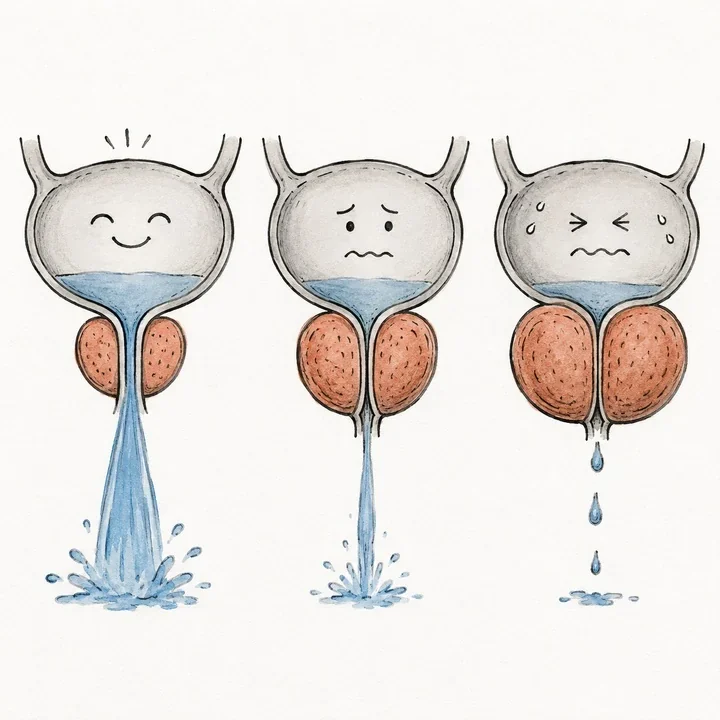
A hand-drawn watercolour illustration of bladder outlet obstruction: an enlarging prostate progressively compressing the urethra below the bladder.
Anatomy drawn by hand.

Oxford Men’s Health

Male fertility, investigated properly

Half of all fertility problems involve the man, and a single abnormal semen analysis is a starting point rather than a verdict. A great many couples are sent straight to IVF without the male side ever being examined.

The honest trade-off Patency and pregnancy are different figures. A reversal can restore sperm to the ejaculate in the great majority of men and still not produce a pregnancy, because that depends on the interval since vasectomy, on female age and on other factors entirely. Any surgeon quoting one number without the other is quoting the flattering one.

Written and reviewed by Mr Musaab Yassin, Consultant Urological Surgeon & Andrologist. FRCS (Urol) · GMC 6118378 ·

An operating microscope beside a monitor displaying a magnified spermatozoon and its analysis.
The two halves of the work: the laboratory that counts and grades the sperm, and the microscope that goes looking for them.

Peyronie’s disease, and a shape that has changed

A change in shape arrives without warning, is difficult to raise with anyone, and is too often met with “nothing can be done”. That has not been true for a long time.

The honest trade-off Plication straightens moderate curves in 85–95% with very little risk to erections, but shortens by roughly 1 cm for every 15 degrees corrected. Grafting preserves length and handles severe curves, at a 15–25% risk of new erectile dysfunction. Where erections have already failed, an implant corrects both problems at once — but permanently replaces natural erectile tissue.

Written and reviewed by Mr Musaab Yassin, Consultant Urological Surgeon & Andrologist. FRCS (Urol) · GMC 6118378 ·

Perovial, the hyaluronic acid preparation used for intralesional injection in Peyronie’s disease.
Perovial — the hyaluronic acid preparation used for intralesional injection while the disease is still active. Manufacturer’s image, IBSA.

Erectile dysfunction, treated as a finding rather than a nuisance

An erection depends on arteries, nerves, hormones and mood all working at once. “Try a tablet” is a reasonable first move and a poor substitute for knowing which of those four has given way.

The honest trade-off The ladder runs in one direction only. Tablets, vacuum devices and injections are all reversible — stop them and nothing has been lost. An implant produces the most dependable erection available and the highest satisfaction of any treatment for this problem, and it permanently replaces the natural erectile tissue, so nothing further can be tried afterwards. That is why it is the last rung rather than the first, and why the discussion takes a full appointment.

Written and reviewed by Mr Musaab Yassin, Consultant Urological Surgeon & Andrologist. FRCS (Urol) · GMC 6118378 ·

The male symbol drawn as a blood vessel: an arterial tree branching inside the ring, and a cut section of the vessel showing blood arriving and draining away.
Blood in, and blood kept.

Oxford Men’s Health

Leaking after prostate treatment

Incontinence after a prostatectomy or radiotherapy is common, rarely discussed, and frequently endured for years on the assumption that it is permanent. It usually is not.

The honest trade-off Once a sphincter is fitted, no catheter may be passed by anyone who does not know the device is there and how to deactivate it first. That single fact belongs on a card in your wallet — or on a bracelet, which is what the national consensus suggests, since it speaks for you when you cannot — and it is discussed at length before any implant is agreed.

Written and reviewed by Mr Musaab Yassin, Consultant Urological Surgeon & Andrologist. FRCS (Urol) · GMC 6118378 ·

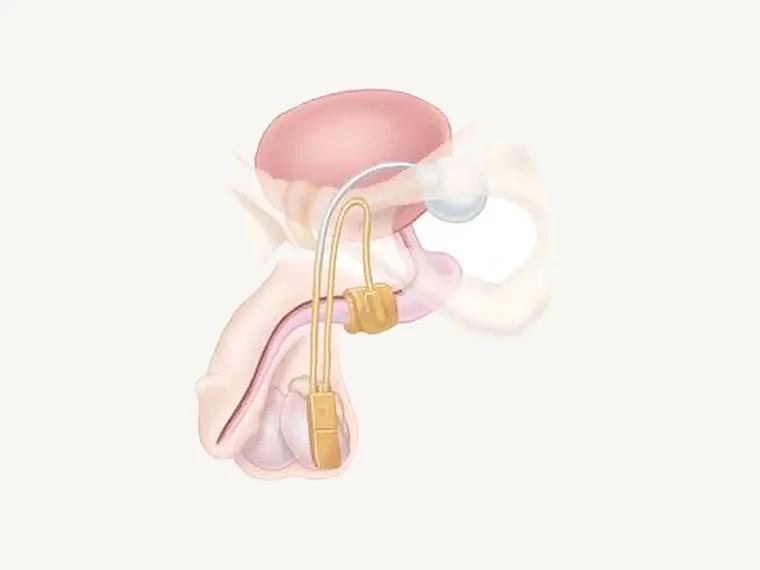
Illustration of an artificial urinary sphincter in place: a cuff around the urethra, tubing to a pump in the scrotum, and a pressure-regulating reservoir behind the abdominal wall.

Oxford Men’s Health

Everyday urology

Kidney stones, and the question of whether to wait

Most men arrive having already had the pain and already had the scan. The question they want answered is narrower than the one they ask: will this one pass, and what happens if it does not.

When this is not a clinic appointment Stone pain with a fever is an obstructed, infected kidney until proven otherwise, and it needs drainage the same day rather than antibiotics and a wait. So does being unable to pass urine at all. Neither belongs in a private outpatient diary — go to an emergency department, and let the clinic sort out the cause afterwards.
The honest trade-off Removing the stone is the easy half. Stone disease is recurrent by nature, and the men who come back within two years are almost always the ones whose first stone was treated without anyone asking why they made it. If this is your second, the assessment should include stone analysis and a metabolic work-up, not just a plan for the one that is there now.

Written and reviewed by Mr Musaab Yassin, Consultant Urological Surgeon & Andrologist. FRCS (Urol) · GMC 6118378 ·

Common Questions

Fifty-five questions men ask before they book.

Most men arrive having already decided their symptom is age, or that nothing can be done about it, or that they would be wasting the appointment. These are short, referenced answers to the questions that come before a diagnosis exists — written to be read at eleven at night, by someone who has not told anyone yet. Each card shows three; the rest are one click behind them.

Prostate health and urinary symptoms

Flow, frequency, waking at night, and the prostate-cancer question.

Only 17% of men over 50 know these symptoms are not a normal part of ageing.

  1. 01Is this just my age?
  2. 02What can actually be done?
  3. 03Why you wake three times a night
  4. 04Do urinary symptoms mean prostate cancer?

Prostate surgery

Choosing between the operations — and what each one costs you in sex, recovery and durability.

A third of men report significant regret after this surgery — usually about expectations, not complications.

  1. 01Which operation should I have?
  2. 02Which operations preserve ejaculation?
The other seven 7 questionsClose
  1. 03Will HoLEP cost me my ejaculation?
  2. 04Will HoLEP affect my erections?
  3. 05How long will the catheter stay in?
  4. 06Why am I worse before I am better?
  5. 07Will I leak afterwards?
  6. 08Will I need it done again?
  7. 09Driving, work, blood thinners and tissue

Everyday urology

Blood, infection, stones, pain, lumps, foreskins and vasectomy — and what going private actually buys.

Across 229,701 people investigated for visible blood in the urine, 17% had bladder cancer.

  1. 01Am I wasting the doctor’s time?
  2. 02Blood in the urine
The other nine 9 questionsClose
  1. 03A fourth course of antibiotics
  2. 04Chronic pelvic and testicular pain
  3. 05A lump in the scrotum
  4. 06Your first appointment
  5. 07My foreskin won’t retract
  6. 08My stricture keeps coming back
  7. 09Will this stone pass on its own?
  8. 10Vasectomy: how permanent is permanent?
  9. 11Going private: what you are buying

Each is referenced to guidelines, systematic reviews and trials, with the studies listed at the foot of the page. Where you already have a diagnosis and are choosing between treatments, the Evidence Notes appraise each option instead.

Evidence Notes

Read the case against a treatment, before you agree to it.

Every device company publishes its best trial and every clinic quotes the most flattering figure from it. These are appraisals of what the published evidence actually supports — including the unflattering findings, and the places where good studies disagree with one another. Twelve notes in all: four of them here, and each condition page carries its own.

Further reading

The other eight notes are in the full collection, and each condition carries its own on its page: enlarged prostate, male fertility, Peyronie’s disease, erectile dysfunction, continence, everyday urology.

StrongRandomised trials and systematic reviews agree.
ReassuringConsistent, but resting partly on observational work.
ModerateReal, from smaller or less rigorous studies.
LimitedToo little evidence to rely on. Said plainly.
Open all twelve notes → How to read a trial result

Your consultant

You should know who you are going to be sitting across from.

Mr Musaab Yassin, Consultant Urological Surgeon and Andrologist.
The official record

Fees, private activity and patient feedback for every consultant in private practice are published by PHIN, under an order of the Competition and Markets Authority. It is not a directory I pay to appear in, and I cannot edit what it says.

Consultant-verified · updated 11 June 2026 Open the PHIN profile ↗

Mr Musaab Yassin is a Consultant Urological Surgeon and Andrologist with fellowship training in andrology and reconstructive urology.

His NHS practice spans Oxford University Hospitals and Imperial College Healthcare NHS Trust in London; his private practice is Oxford Men’s Health, one of the member practices of Oxford Urology Associates LLP — a partnership through which a group of independent consultant urological surgeons work alongside one another, their subspecialist interests covering the whole of urology between them. He consults at Nuffield Health The Manor Hospital in Oxford and The Lister Hospital in central London.

That matters more than it sounds. If what you turn out to need is a uro-oncologist rather than an andrologist, you are referred sideways to a colleague in the same group rather than sent back to your GP to start again.

The sub-specialist interests are prostate surgery at any gland size, male fertility microsurgery, and reconstruction after prostate cancer treatment — three areas that share a requirement for technique rather than volume, and where the difference between an adequate and an excellent result is usually made by the operator.

What you should expect from the consultation is a straight account of what each option would cost you as well as what it would give you — and a recommendation against surgery when that is the honest answer. Consultations are available in English and Arabic.

Royal College of Surgeons of England British Association of Urological Surgeons European Association of Urology American Urological Association European Society of Sexual Medicine GMC 6118378 · FRCS (Urol)

Patient experience

Reviews I do not control, on platforms that verify them.

All three publish independently and confirm the reviewer was a patient. None of them lets me edit, curate or remove what is written — which is the only thing that makes a rating worth reading. PHIN is the body the Competition and Markets Authority requires to publish private healthcare performance data.

“Mr Yassin was the most kindest and helpful consultant and put me at ease.”

Verified patient review

“A great doctor and extremely reassuring throughout.”

Verified patient review

Ratings and review counts verified on 27 August 2026 and reproduced as published. They change as new reviews are added, so the platforms themselves are the current record. PHIN publishes procedure volumes, fees and patient-reported outcomes for private consultants under a Competition and Markets Authority order; its page was last updated 11 June 2026 and is verified by the consultant.

Patient films

Two patients, in their own words.

Both men had Aquablation for an enlarged prostate under my care, and both agreed to be filmed by Nuffield Health afterwards. The practice had no hand in what they said.

Steve Clark Overcoming BPH
Overcoming BPH: Steve Clark’s journey. Filmed by Nuffield Health. Nothing loads from YouTube until you press play.
Mark Oliver Finding relief
Finding relief: Mark Oliver’s BPH journey. Filmed by Nuffield Health. Nothing loads from YouTube until you press play.

Cost and access

What it costs, and how you get in.

Published up front, because the two things that stop men enquiring are not knowing the price and not knowing whether they are allowed to.

Consultation £295

A full consultant assessment, examination, and a written plan. Follow-up £190. You are under no obligation to proceed with anything.

Referral Not required

Self-funding patients may book directly. GP and consultant referrals are equally welcome, and are usually seen faster than the NHS pathway.

Insurance Accepted

Check your policy covers the relevant treatment and obtain any pre-authorisation your insurer requires before the appointment.

Where Oxford & London

Nuffield Health The Manor Hospital in Oxford, and The Lister Hospital in central London.

How an appointment works

Get in touch

Call, email or send the form below. You will be asked what the problem is in general terms and where you would prefer to be seen — nothing more at that stage.

Prepare in fifteen minutes

Complete the questionnaire that matches your reason for coming. It stays on your own device, and it means the consultation is spent on you rather than on definitions.

The consultation

History, examination, and any tests that would change the plan. You leave knowing what is happening, what the options are, and what each would cost you — not only in money.

Decide in your own time

Nothing is booked on the day unless you want it to be. A great many consultations end with a recommendation to do nothing yet, and that is a legitimate outcome.

Before you get in touch

The questions men actually ask first.

Do I need a referral from my GP?

Not to book privately as a self-funding patient — you can contact the practice directly. If you are using insurance, most insurers require a GP referral before they will authorise the appointment, so check your policy first.

Will my GP be told?

Only with your agreement. Writing to your GP is normally good practice, because it keeps your records complete and matters if you later need medication or emergency care. If you would prefer that not to happen, say so at the consultation and it will be respected.

What will it cost in total?

The first consultation is £295, and a follow-up is £190. Anything beyond that — imaging, tests, a procedure — is quoted in writing before it is arranged, so you never receive an invoice you have not already seen. These are the same figures published on my PHIN profile, which is the official record.

I have been putting this off for years. Is it too late?

Very rarely. Delay changes which options are open, but almost never closes all of them. Continence after prostate surgery, Peyronie's disease and a vasectomy from fifteen years ago are all still treatable, and the men who wait longest are usually surprised by how much can still be done.

What if I do not need surgery?

Then you will be told so plainly. A significant proportion of consultations end with watchful waiting, a medication change or reassurance. A recommendation against an operation is a legitimate result of an assessment, not a failed one.

How private is this, really?

Consultations are confidential and correspondence is sent where you ask for it to be sent. Nothing on this website is tracked back to you, the questionnaires stay on your own device, and no clinical detail should be sent by WhatsApp — use it for appointments only.

Can I be seen in London instead of Oxford?

Yes. Consultations run at The Lister Hospital in central London as well as at the Manor in Oxford. Where a procedure is involved, it is worth discussing which site suits it — some are better done at one than the other.

Do you speak Arabic?

Yes. Consultations are available in English or Arabic, and it makes a real difference to conversations of this kind to have them in your first language.

Before you pay anyone

Ten questions worth asking — including of me.

The moment you step outside the NHS you stop being a patient on a list and start being someone spending their own money. That change of position is legitimate, and it comes with questions most people feel awkward asking the person they are about to pay. They are the right questions. Here they are, with what the published evidence says about each, and with this practice’s own answer set out beside it — so you can hold it to the same standard as anyone else’s.

Money What you will actually pay 3 questions

The three places private care becomes more expensive than the quote: what the quote leaves out, what happens if something goes wrong, and what your insurer declines.

Is this quote truly all-inclusive, or will bills arrive later?

Ask for the exclusions rather than the price. The number is easy; the list of what it does not contain is where the surprises live.

UK private providers have been required to publish price information through PHIN since the Competition and Markets Authority reforms, and yet the evidence is that price information remains hard for patients to reach and often incomplete. Across the wider price-transparency literature, patients who do use pricing tools tend to choose less costly providers — but uptake is low, and most published prices describe a single service at list rate rather than what one episode of care will actually cost one person.

That is the whole problem in a sentence. A surgeon’s fee is not a price. The question that produces a usable answer is: does this figure include the surgeon, the anaesthetist, the hospital facility fee, routine bloods, imaging, any implant or consumable, follow-up appointments, and a defined period of cover if there is a complication? Bundled, patient-specific episode pricing is what the evidence supports as the format that actually prevents bill shock. Anything short of it leaves a gap, and the gap is always filled at your expense.

The answer here A first consultation is £295 and a follow-up £190. Everything beyond that — imaging, tests, a procedure — is quoted in writing before it is arranged, so no invoice arrives that you have not already seen. Those figures are the same ones published on my PHIN profile, which is the official record and not something I control. Hospital and anaesthetist fees are separately set by the hospital; ask for them in the same written quote rather than separately, and if any provider declines to give you one document, treat that as the answer.

Araich 2023, Br J Radiol, price transparency in North America and Europe · AMA J Ethics 2022, which price should be transparent · Zhang 2020, Health Policy, scoping review of price transparency · Sabanovic 2023.

If it fails, or there is a complication, do I pay the full fee again?

This is the single most expensive thing to leave unwritten, and the one most often left unwritten.

Complications are not merely unpleasant; they are the point at which apparently affordable care becomes unaffordable. In a large claims analysis, patients who had a complication stayed 12.4 days rather than 3.9, and the additional cost outran the additional payment. A study in JAMA Surgery found mean hospital costs $19,626 higher where a complication occurred. Those are American figures and the arithmetic does not transfer to the UK — but the shape does, and a UK service evaluation of private-sector cosmetic complications referred on to one London NHS plastics unit put the cost of fourteen patients in a single year at £16,471, borne by the NHS rather than by the provider who operated.

So the question is not “what is your complication rate” alone. It is: what specifically is covered, for how long, and by whom — readmission, a return to theatre, a revision procedure, an extended stay, critical care, and the follow-up that goes with them? Get the period in writing with a date on it. Most UK fixed-price packages include some defined complication cover; they differ enormously in its length and in what sits outside it.

The answer here The complication terms attached to any procedure are set out in writing with the quote, before you commit to anything — what is covered, for how long, and what is not. If a proposed operation carries a realistic chance of needing a second one, you will be told the figure before you decide, not afterwards.

Haidar 2023, J Comp Eff Res, Medicare claims · Healy 2016, JAMA Surgery · Br J Surg 2021, cosmetic surgery complications referred to a London tertiary plastics service · Venditto 2020; Yu 2026.

Will my insurer actually pay, or find a reason not to?

“Do you take Bupa?” is not the question. Whether every clinician in your pathway is fee-assured with your insurer is.

Having insurance and being fully covered are different things. In one audit of billing for privately insured inpatients, 98.5% still had some out-of-pocket spending, and half paid up to 30% of the episode themselves. In a US analysis of more than five million admissions, patients treated at an in-network hospital still received an out-of-network bill in up to 42% of inpatient cases — because the hospital was in-network and one of the clinicians was not. Even after legislation designed to stop that, overall high-burden medical spending did not clearly fall.

The British version of this is the shortfall: your insurer pays its scheduled rate, the consultant charges more, and you receive the difference. It is entirely legal and entirely avoidable if you ask first. The three questions that prevent it are: is every clinician in this pathway — surgeon, anaesthetist, radiologist, pathologist — fee-assured with my insurer? What pre-authorisation code have you submitted, and has it been accepted? And is any part of this likely to be treated as a pre-existing condition or as chronic rather than acute? Ask before the appointment, not before the operation.

The answer here Insurance is accepted. Check that your policy covers the relevant treatment and obtain any pre-authorisation your insurer requires before the first appointment — that single step prevents most declined claims. If you would rather not involve an insurer at all, the self-pay fees above are published and apply whatever your reason.

Sugunan 2024, AIMS Public Health, hospital billing audit · Sun 2019, JAMA Intern Med, out-of-network billing at in-network hospitals, n = 5,457,981 admissions · Liu 2025, BMJ, spending after the No Surprises Act · Amporfu 2023; Ng 2024.

The surgeon Whether you are buying expertise or access 4 questions

Four questions that separate what private care genuinely provides from what it is merely marketed as providing.

How many of this exact operation do you do, and what is your complication rate?

The most reliably predictive question you can ask, and the one most often answered with a number about years rather than a number about cases.

The volume–outcome relationship is among the most reproducible findings in surgical research. A systematic review of systematic reviews found that most reviews support it; a scoping review found a statistically significant association in 86.6% of studies examining it. The clearest British illustration comes from the National Joint Registry linked to Hospital Episode Statistics — 39,281 shoulder replacements by 638 consultants across 416 units — where surgeons averaging fewer than 10.4 procedures a year carried up to 1.94 times the revision risk of the lowest-risk surgeons. In radical prostatectomy specifically, higher-volume surgeons are associated with lower mortality, morbidity, complications, readmission and cost.

Two honest qualifications. Volume is a proxy, not a measurement: a high-volume surgeon can still be a poor one, and the association is stronger for some operations than others. And any individual surgeon’s complication rate for a rare event is statistically fragile — at a true rate of 2%, a personal series of 300 cases gives a figure with a confidence interval wide enough to cover most honest answers. What genuinely tells you something is whether the surgeon audits at all, what the denominator is, and whether the reply is a number or a mood.

The answer here Ask at consultation and you will be given the annual figure for the specific operation you are considering, the denominator behind it, the revision, complication and readmission rates that go with it, and the published benchmark to hold them against. These are gone through in the room rather than issued as a document. If a figure is small because a procedure is uncommon, you will be told that too, along with where it is done more often.

Morche 2016, systematic review of systematic reviews · Levaillant 2021, scoping review · Valsamis 2023, BMJ, National Joint Registry and HES for England, n = 39,281 · Leow 2017 (radical prostatectomy) · Fischer 2023; Malik 2018; Bedi 2021.

Are you recommending this because I need it, or because it pays better?

A fair question to ask anyone who is paid by the operation, and one you should be able to test rather than take on trust.

The conflict is structural rather than personal: in private practice the person advising you on whether to have surgery is generally the person who is paid to perform it. Pretending that tension does not exist is less useful than showing you how to check. Research on private fee-setting finds that specialists themselves describe pricing as opaque and resist transparency initiatives, which is not evidence of bad faith but is evidence that the information asymmetry is real.

Three questions test it directly. What is the case against this operation? — if the answer is that there isn’t one, you are being sold something. What would happen if I did nothing for six months? — for a great many urological conditions the honest answer is “very little”, and a surgeon who cannot say so is not weighing your interests. And which of the options you have described do you not offer, and why? — a recommendation that happens to coincide exactly with the recommender’s own skill set deserves a second opinion, which no reasonable surgeon will resent you seeking.

The answer here The Evidence Notes on this site exist for precisely this reason: each one appraises a treatment including the findings that do not flatter it, and several of them concern procedures I do not perform. A significant proportion of consultations end in watchful waiting, a medication change, or reassurance — a recommendation against an operation is a legitimate result of an assessment, not a failed one.

Ranasinghe 2023, Soc Sci Med, qualitative study of fee setting and price transparency among private specialists · Araich 2023 · AMA J Ethics 2022.

Am I paying for a better outcome, or just for skipping the queue?

Usually for time, continuity and choice. Sometimes for a genuinely different operation. It is worth knowing which one you are buying.

Reviews of elective surgery delivered by private providers generally do find shorter waits and better access — but the evidence base is largely observational, and some reviews also found healthier case mix and mixed postoperative outcomes, meaning part of the apparent advantage is who was selected rather than what was done. That is the honest version of the speed argument.

Time itself, though, is not nothing. Modelling of the NHS in England estimated real quality-adjusted life-year losses when waits lengthened from 18 to 36 weeks, concentrated in patients from more deprived areas. A matched study in South West England found patients waiting beyond 18 weeks consumed measurably more healthcare while they waited. Against that, a 2026 analysis of hip and knee replacement in England found waiting time did not significantly affect post-operative health or readmission — so the size of the benefit depends heavily on the condition, and anyone quoting one figure for all of them is generalising.

The distinction that matters for you: does the private pathway offer a technology or technique you cannot get on the NHS locally, or the same operation sooner? Both are legitimate reasons to pay. Only one of them justifies a premium over waiting.

The answer here For most of what this practice treats, private care buys time, continuity and a named surgeon — not a different operation. The exceptions are real and specific: microsurgical procedures and some prostate techniques are not evenly available, and where that is the case you will be told plainly which it is. Where the NHS would do the identical thing within a reasonable time, that will be said too.

Rathnayake 2025, review of outsourcing elective surgery · Akpinar 2023 · Gibbs 2024, Med Decis Making, NHS England waiting-time modelling · BMC Health Serv Res 2024, South West England matched cohort · Econ Hum Biol 2026, joint replacement waiting times.

Am I paying to see the same doctor I would have seen on the NHS anyway?

Often, yes — and the honest answer is that this is not the objection it sounds like.

Most UK private consultants also hold NHS posts; I work across Oxford University Hospitals and Imperial College Healthcare alongside this practice. So the person is frequently the same person. What differs is not who, but how much of them you get, and whether they stay with you.

Three things change. The appointment is longer and it is yours. The consultant you meet is the consultant who operates — in the NHS that is often not true, not through bad faith but because lists are staffed by rota and a named surgeon on a letter is not a promise about the theatre. And continuity holds across the whole episode: the same person assesses you, operates, and sees you afterwards, which the handover literature suggests matters more than patients realise. One review of surgical handovers found a quarter were associated with care failures, and that a surgical inpatient may be seen by around ten different doctors during a single admission.

The mechanism behind faster access is also worth stating plainly, because it is rarely said aloud: where private and public patients are treated in the same system, private patients have been shown to wait substantially less and to be admitted ahead of their listing rank. That is what you are buying. Whether it is worth it is a reasonable thing to weigh, and the answer is not always yes.

The answer here You are not buying a different surgeon. You are buying an unhurried consultation, a written plan, the certainty that the person who assessed you is the person who will operate, and one point of contact through the whole episode. If your condition is one the NHS will treat promptly and identically, you will be told so — and you are under no obligation to proceed with anything after a consultation.

Ryan 2024, surgical handover review · Lazzara 2022, Ergonomics, meta-analysis of 41 handoff studies · Johar 2010, waiting times for private and public patients in NSW public hospitals · Markovich 2026, hospital-to-community continuity.

Safety and aftercare What happens when something goes wrong 3 questions

The part of private care that is least visible in the brochure and most consequential at three in the morning.

If something goes seriously wrong, does this hospital have intensive care — or an ambulance?

A hospital question rather than a surgeon question, and one you should ask the hospital directly and get in writing.

Independent hospitals in the UK vary enormously in what they can manage, and the regulator has said so. When the Care Quality Commission reported on 206 independent hospitals in England, 62% were rated good and 8% outstanding — but almost a third required improvement overall, and 41% required improvement on safety specifically, which was the regulator’s single greatest concern. A more recent cross-sector study found independent hospitals scoring higher on average CQC ratings than NHS providers, while cautioning that narrower case mix and specialisation probably explain part of that difference. Both findings are true, and neither tells you about the building you would actually be admitted to.

Ask four specific things, of the hospital and not of the consultant: Is there level 3 critical care on this site, or level 2 only? Is there a resident doctor in the building overnight, and what grade? If I deteriorate, what is the transfer arrangement, to which NHS hospital, and how long does it take? And has anyone been transferred out after this operation in the past year? Many private hospitals have overnight resident medical cover without on-site intensive care, and those are genuinely different things. A hospital that answers precisely is telling you something; one that answers “we have full facilities” is telling you something else.

The answer here Consultations and procedures run at Nuffield Health The Manor Hospital in Oxford and The Lister Hospital in central London, and the two sites are not interchangeable for every procedure. Where an operation is involved, which site suits it is part of the discussion rather than an administrative detail — some are better done at one than the other, and that judgement takes account of exactly the facilities above. Each hospital will confirm its own critical care provision and escalation arrangements in writing on request, and you should ask.

Iacobucci 2018, BMJ, CQC report on 206 independent hospitals in England · Bullen 2025, Int J Qual Health Care, determinants of quality in the independent and public sectors in England · Atkinson 2021, on interpreting reported infection rates alongside surveillance audit quality.

If I am in pain at two in the morning on a Sunday, who do I call?

Ask for the route by name before you are discharged, not after. And be sceptical of anyone who implies no problem could ever need a different hospital.

Out-of-hours contact is common enough to plan for rather than to treat as exceptional. In one surgical cohort 23.2% of patients made after-hours calls, mostly about symptoms or practical questions — and clinician-initiated follow-up substantially reduced how many. In a private practice, improving preoperative education cut total after-hours calls by 22%, almost entirely by removing the non-urgent ones. Most such calls are not emergencies: in one series only 7.2% led to an emergency department referral, and in a helpline dataset only 11.9% were urgent, with most resolved during the call or the next working day.

The discharge period is where private care most often quietly fails. A 2025 qualitative systematic review found patients frequently feel insecure and left responsible for complex self-care at home, and that expectations shape how the whole recovery feels more than the events themselves do. Structured handover measurably helps: a meta-analysis of 41 studies found standardised post-operative handoffs improved patient outcomes with an odds ratio of 1.49.

So ask: which number do I ring at two in the morning, and who actually answers it — a ward, a colleague, or a call centre? Who do they escalate to, and how quickly? And what happens if the problem turns out to need more than this hospital can provide? That last one is the question providers are vaguest about, and the honest answer is that it occasionally happens — particularly where the problem is a medical one rather than a surgical one. Most private hospitals have no emergency department, so what a good pathway gives you is not a promise that it never happens. It is a route settled in advance: a number that answers at any hour, a named consultant it escalates to when a problem is not straightforward, and a team that arranges the move if one is needed.

The answer here On discharge you are given a direct number for the ward, answered by the nursing coordinator, with medical support behind it. That is the first call, at any hour — not the office, and not email. The team troubleshoots most problems on the telephone, and escalates to the consultant in charge whenever a situation is not straightforward. If you need face-to-face assessment rather than advice, the Manor can generally provide it; occasionally a problem needs a different specialty, and that is arranged through another hospital rather than left to you. The practice office on 01865 307733 can be used during the day, but it should not be your first port of call, and email and WhatsApp are for non-urgent matters only — they are not monitored out of hours. Behind all of that sits the safety net: if you cannot pass urine at all, or the problem is plainly more urgent than a telephone call, go to your nearest Accident and Emergency department and tell them what surgery you have recently had.

Blumenthaler 2021, after-hours calls after surgery · Harbour 2023, private practice after-hours call reduction · Kofina 2022; Chong 2022 · Sig 2025, qualitative systematic review of discharge and home recovery · Lazzara 2022, Ergonomics, meta-analysis of 41 handoff studies · Duffy 2025; Ryan 2025.

Will I get a proper conversation, or ten minutes and a leaflet?

Ask what the booked appointment length actually is. It is a scheduling fact, and any practice can tell you.

This sounds like a question about manner. It is really a question about outcomes. The discharge and recovery literature keeps arriving at the same finding: what patients were led to expect shapes how well the recovery feels, sometimes more than what happened to them clinically. In a study of men recovering from prostate surgery, every patient had been told bleeding was possible, but 93.5% expected it to stop within thirty days — and one who bled to day 23 was convinced something had gone badly wrong. Nothing had. The complication was in the counselling.

Which means the time is not a courtesy. It is where the questions you have already researched get answered, where your actual risk profile gets discussed rather than the average one, and where you find out what to expect closely enough that ordinary recovery does not read as disaster. If you arrive with a list, a good consultation gets through the list.

The answer here A consultation is a full consultant assessment: history, examination, any tests that would change the plan, and a written plan you take away. You leave knowing what is happening, what the options are, and what each would cost you — not only in money. There is a short questionnaire for each condition on this site; completing it beforehand takes about fifteen minutes and means the appointment is spent on you rather than on definitions. Bring the list. It is welcome.

Sig 2025, qualitative systematic review of patient experience after discharge · Assmus 2021, CUAJ, patient expectations and understanding of recovery · El-Boghdadly 2024, Anaesthesia, Association of Anaesthetists and British Pain Society consensus.

In writing Four things to have on paper before you book 4 things

Anywhere, with anyone. A provider who will put these in writing is telling you how they work; one who will not is telling you the same thing. The surgeon’s own figures are a separate matter: those are gone through at the consultation rather than issued as a document, and what to ask for is set out under the surgeon above.

  1. The all-inclusive priceOne document covering surgeon, anaesthetist, hospital, tests, implants and follow-up — and an explicit list of what sits outside it.
  2. The complication termsWhat is covered if there is a readmission, a return to theatre, a revision or a longer stay — and for how long, with a date on it.
  3. Who is responsible afterwardsThe named consultant accountable after discharge, whether you will see the same person, and what the follow-up schedule is.
  4. The out-of-hours routeThe number you are given on discharge, who answers it at two in the morning, who they escalate to, and what happens if a problem needs a different hospital.

This is general guidance drawn from published research on private healthcare, not advice about a particular policy, quote or operation — review those with the provider, your insurer and a clinician. If you are weighing a specific treatment, the Evidence Notes set out the case against each one; the costs and access for this practice are published above, and the practical questions above cover referrals, insurance and privacy.

Written and reviewed by Mr Musaab Yassin, Consultant Urological Surgeon & Andrologist. FRCS (Urol) · GMC 6118378 ·

The Oxford skyline at dusk, with the dome of the Radcliffe Camera.

Where you would be seen

Specialist care, rooted in a world-leading medical city.

Oxford concentrates an unusual amount of urological expertise in a small place. The private practice sits alongside that rather than apart from it.

The consulting rooms

Three clinics, and what to expect at each.

Consultations run in Oxford and central London, with a third Oxford site to come. Where a procedure is involved it is worth discussing which site suits it — some are better done at one than the other, and one of the three will be day-case only.

Nuffield Health The Manor Hospital, Oxford, at dusk.

Nuffield Health The Manor Hospital

Beech Road, Headington, Oxford OX3 7RP.

Consulting rooms, imaging and operating theatres on a single site, so an ultrasound or flow test can usually be done at the same visit rather than at a second appointment. On-site parking. Roughly fifteen minutes from Oxford Parkway by taxi.

Directions ↗
The Lister Hospital, Chelsea Bridge Road, London.

The Lister Hospital

Chelsea Bridge Road, London SW1W 8RH.

Central London consulting, a short walk from Sloane Square and about ten minutes from Victoria. Convenient for patients travelling in for the day, and for anyone who would rather not be seen at their local hospital.

Directions ↗
The Churchill Hospital, Oxford University Hospitals, at dusk.

NHS practice

Oxford University Hospitals and Imperial College Healthcare.

The complex reconstructive and prosthetic work in this speciality is concentrated in the NHS units, and that experience is what the private practice draws on. Referrals move in both directions where that is the right thing for the patient.

OUH urology team ↗
Welbeck Oxford, a new private hospital, shown in an architect’s visualisation.

Welbeck Oxford Opening soon

Jordan Hill Business Park, North Oxford.

A new day-case hospital, and the third site at which I will consult. Laminar-flow theatres, two MRI scanners, CT and digital X-ray on one site, an on-site pharmacy, and en-suite recovery pods rather than wards. Men’s health is one of its named specialties.

That makes it well suited to consultation, imaging and day-case work — and not the place for an operation that needs an overnight stay, which is a distinction worth making before you choose where to be treated. The opening date is not yet fixed; until then appointments run at The Manor and at The Lister exactly as now, and nothing about a booking already made changes.

About the hospital ↗

Arrange a consultation

Bring the questions with you — they will be answered with numbers.

A full consultant assessment, examination and a written plan is £295. Self-funding patients may book directly without a referral; insured patients usually need an open referral and an authorisation number first. You do not need to explain the problem in writing — a general heading is enough, and the detail belongs in the room.

In writing Send a few details.

A short form. It opens your own email app with the message already written, so you keep a copy and stay in control of what is sent.

Compose the enquiry

This form does not send anything by itself and stores nothing. It opens your own email app in a new tab with the message written for you, so you stay in control of what is sent and you keep a copy. If your browser blocks that, or this page is being viewed inside another app, the message appears below instead and you can copy it. What the practice does with your details is set out in the privacy notice.

Your email app did not open

Nothing is lost. Copy the message below and send it to admin@oxfordmenshealth.uk, or ring 01865 307733 during the week.

WhatsApp Message the practice.

For practical questions — appointments, timings, paperwork. Please do not send clinical details, results or images this way.

Open WhatsApp →
Telephone 01865 307733

Answered on weekdays by the practice team, who handle appointments, fees and insurer authorisation. Clinical questions are passed to me.

Call →
Email Write to the practice.

Best for reports, scans and paperwork, and for anything you would rather set out at your own pace.

Show the address
The address admin@oxfordmenshealth.uk

Copy it into whichever email you use, or open it in your own email app.

Open in your email app
What it costs

£295 for the first consultation and £190 for a follow-up. Anything further — a scan, a procedure, an operation — is quoted in writing before it is arranged, and nothing is booked until you have seen the figure. The costs section sets out what each treatment runs to.

How patients pay

Self-funding, private medical insurance and international sponsorship are all accepted. Insurers usually want a referral and an authorisation number before the appointment. Self-funding patients may book without a referral at all.

Who answers, and when

The telephone is answered by the practice team on weekdays — appointments, fees, referral letters and insurer authorisation, with clinical questions passed to me. Email — admin@oxfordmenshealth.uk — suits reports, scans and paperwork. WhatsApp is for practical questions only: please do not send clinical details, results or images to it.

If it will not wait

If you cannot pass urine at all, have a fever with urinary symptoms, or are bleeding heavily, call 111, or 999 if you are seriously unwell, and go to your nearest emergency department — telling the staff there what surgery you have recently had. This practice cannot provide emergency care, and the enquiry form, email and WhatsApp are not monitored out of hours.

Oxford Men’s Health consults at Nuffield Health The Manor Hospital, Beech Road, Headington, Oxford OX3 7RP, and at The Lister Hospital, Chelsea Bridge Road, London SW1W 8RH. Consultations are held in English or Arabic — say which you would prefer when you enquire.

Before your visit

Fifteen minutes now saves twenty in the room.

Complete the questionnaire that matches your reason for coming. Nothing is saved or transmitted — you print the summary or copy it into an email, and it stays entirely in your control. For erectile dysfunction, stones and everyday urology, bring any recent scans or results; a questionnaire for men’s sexual health is in preparation.

What to bring Three things

Any previous scans or reports, a list of your current medication, and the completed questionnaire if you have had time.

How long Allow up to an hour

The consultation itself takes at least twenty minutes. Allow up to an hour if you are having a flow test, a scan, bloods or a urine test on the day.

Coming with someone Welcome

Partners are welcome throughout, and for fertility discussions it is often better if you both come.

Referring a patient?

Referrals are accepted by email to admin@oxfordmenshealth.uk or by telephone on 01865 307733; no proforma is needed, and a few lines are enough to start. Clinical questions without a referral go to advice@oxfordmenshealth.uk, which reaches me rather than the appointments team.

What helps a referral move quickly, what is seen the same week, which presentations are emergencies rather than referrals, and the evidence appraisals, are on the page for referrers.

Call the practice Send an enquiry