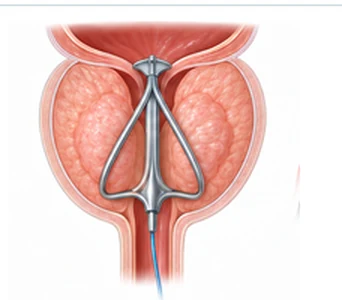
What I treat · Prostate & urinary flow
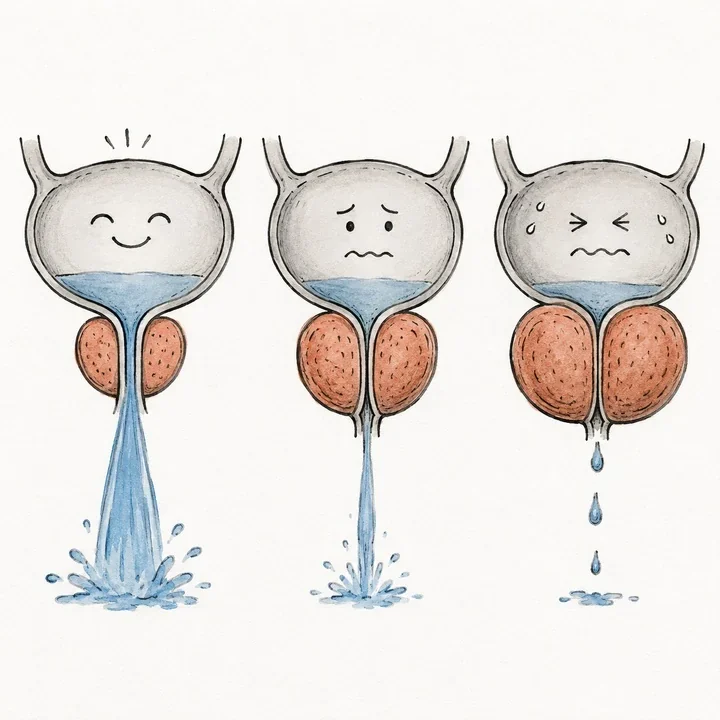
By sixty, most men have some prostate enlargement. The question is never whether you have it — it is whether it is obstructing you, and which of six treatments fits your gland and your priorities.
Assessment measures rather than guesses: symptom score, flow rate, how much urine is left behind, and the size and shape of the gland on imaging. That determines whether you need an operation that removes tissue, one that preserves ejaculation, or nothing at all for the time being.
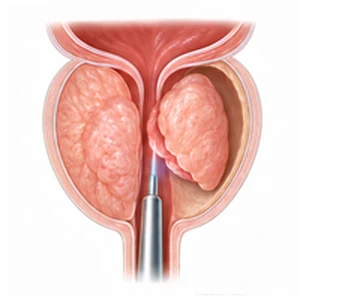
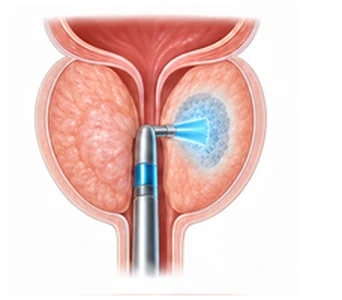
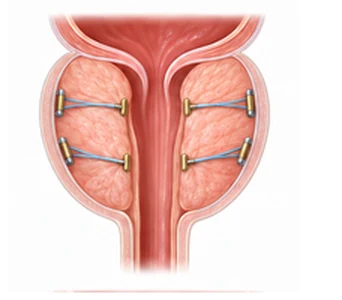
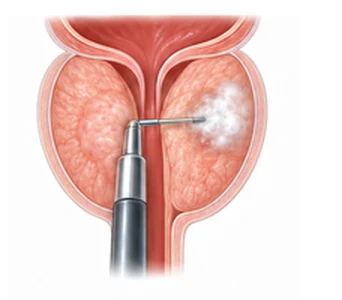
Where surgery is right, HoLEP handles any gland size with ten-year durability behind it; Aquablation removes substantial tissue while usually keeping ejaculation; Rezūm and UroLift protect sexual function at the cost of some completeness. All nine are set out side by side, with the figures that do not flatter them, in the comparison table.
The anaesthetic differs too, and it matters to more men than the brochures suggest. HoLEP is performed under a spinal anaesthetic with sedation in most cases, so you are comfortable and drowsy rather than fully asleep — a general is used where a spinal is unsuitable or you would prefer one. Aquablation requires a general anaesthetic. Rezūm is done under a local anaesthetic with sedation, and needs no general at all.
The leaflets above are published by the British Association of Urological Surgeons (BAUS) and open in a new tab. They are linked, not hosted or altered.
Written and reviewed by Mr Musaab Yassin, Consultant Urological Surgeon & Andrologist. FRCS (Urol) · GMC 6118378 ·
Oxford Men’s Health
Two patients, in their own words
Both men had Aquablation for an enlarged prostate under my care, and both agreed to be filmed by Nuffield Health afterwards. The practice had no hand in what they said.
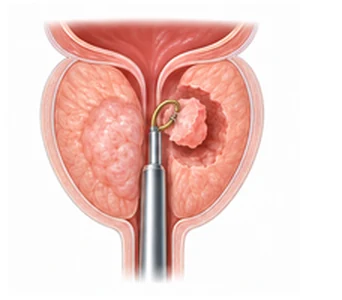
HoLEP · before you decide
Most men considering HoLEP have already read r/BPH at one in the morning. The questions there are sharper than the ones asked across a desk, and they deserve the same answer either way. These are the eleven that decide whether to have the operation and who should do it — answered from the published evidence, including the figures that do not flatter it. The questions about recovery itself are answered in the HoLEP guide, which is written for after you have decided. Where the question is which operation rather than which surgeon, the side-by-side comparison sets all nine out against one another.
The forums are right that this matters more than the brochure — and roughly right about the numbers. They are usually wrong about why.
Broadly yes — but the threshold depends on which thing you are asking experience to protect.
Three different curves are usually collapsed into one number. The older literature settled on 30 to 50 cases for operating time and enucleation efficiency to plateau, from a systematic review of 17 studies covering 4,615 enucleations by 76 surgeons. That figure is where the “HoLEP takes 50 cases” claim comes from, and it is a claim about speed.
Safety takes longer. The most careful recent analysis looked at 1,724 procedures by six surgeons, three of whom had passed 200 cases, specifically to see what happens beyond the textbook plateau. Efficiency was still improving past 200. Complication rates — bleeding needing coagulation at 4.7%, retention at 9.3% — only became stable after about 350 cases.
Continence has a lower threshold of its own. Across 2,346 men at multiple centres, a surgeon having done at least 40 cases was one of only two independent predictors of being dry at three months.
And some things never improve with volume at all. A single surgeon's first 500 consecutive cases showed operating time falling steadily from 67 to 43 minutes, with no measurable learning curve in blood loss, complications or length of stay.
So the forum advice is directionally sound. A surgeon at 100 cases is not dangerous; one at 500 is faster, more predictable and less likely to leave you leaking at three months. What volume does not buy is immunity: a prospective series by an experienced surgeon — published under the title “…even in the hands of an experienced surgeon following completion of the learning curve” — still recorded complications in 14.8% during the admission and 14% in the first month after discharge. Ask the number, and expect a number rather than a reassurance.
Enikeev 2020, World J Urol, systematic review, 4,615 enucleations · Glienke 2025, J Endourol, 1,724 procedures · Houssin 2020, World J Urol, n = 2,346 · Wenk 2024, World J Urol, 500 consecutive cases · Capogrosso 2023, Eur Urol Focus · Robert 2016, BJU Int.
A fair question, and a specific one — because the two halves of the operation carry different risks.
Enucleation is where the sphincter and the ejaculatory structures are at stake. Morcellation is where the bladder is. They are not interchangeable skills, and the published injury signal sits almost entirely in the second: across 10,371 procedures, bladder injury occurred in 2.4%, ureteric orifice injury in 0.4%, capsular perforation in 2.2% and incomplete morcellation in 2.3%.
That risk is technique-dependent rather than device-dependent. A comparison of 34 studies across the Wolf Piranha, Lumenis VersaCut, Storz DrillCut and others found comparable performance and safety, with no consistent advantage for any device. One high-volume centre reported zero bladder mucosal injuries across 1,016 consecutive cases. What separates those results is bladder distension, complete haemostasis before morcellation starts so the view stays clear, keeping the device central, not chasing small fragments, and stopping the moment visibility is lost.
In this practice the consultant you meet is the consultant who operates, on both halves of the procedure. If you are seen anywhere else, ask for that in the same plain terms, and ask for it to be written on the consent form rather than said in the corridor.
Porreca 2021, Minerva Urol Nephrol, systematic review, 10,371 procedures · Mokhtarzadehazar 2026, J Endourol, meta-analysis, 7,211 patients · Whiting & Cynk 2018, 1,016 consecutive cases · Stutz 2018; Maheshwari 2018.
Worth asking — but worth knowing that any single surgeon's figure for a rare event is statistically fragile.
At a true rate of around 2%, a personal series of 300 cases produces a number with a confidence interval wide enough to cover most honest answers. What is genuinely informative is whether the surgeon audits at all, what the denominator is, and whether the answer arrives as a figure or as a mood. Ask at consultation and you will be given the figure and the denominator behind it.
These are the benchmarks to hold any answer against:
A surgeon quoting figures materially below all of these is either exceptional or not counting the same things. Both are worth a second question.
Porreca 2021, 10,371 procedures · Masiha 2025 (DayLEP), Br J Surg, n = 441, three UK centres · Michel & Nimmagadda 2025, J Endourol, national claims database, n = 11,559 · Glienke 2025; Ibrahim 2019; Yim 2025.
Size is the variable HoLEP is least troubled by, which is most of its argument.
A tertiary centre compared 157 men with prostates of 200 cc or more against 157 consecutive cases of 80–199 cc. Enucleation was faster per gram in the larger group (2.8 vs 2.1 g/min). Symptom scores, flow rate, residual volume, success of the first trial without catheter and three-month continence were all no different. What did differ: haemoglobin fell further (19 vs 12 g/L), transfusion ran at 4.5% against 1.3%, and length of stay was one day longer.
“Conversion” in HoLEP does not mean opening the abdomen. It means needing a different route to get the tissue out — a cystotomy, or resecting nodules rather than morcellating them. In that series it was required in 5.7% of the 200 cc-and-above group, and in none of the group below 200 cc.
At 150 cc you are comfortably inside routine territory. The UK multi-centre series had a mean prostate volume of 111 cc with 20.8% of men anticoagulated, and found that a volume above 120 cc was not associated with more complications or worse outcomes — 51% still went home the same day. Same-day discharge has been reported as feasible even at 175 cc and above, though the men who end up admitted after a planned day case do tend to have the larger glands (152 vs 101 mL) and the longer morcellation times.
Boxall 2021, World J Urol, 157 vs 157 · Masiha 2025 (DayLEP), n = 441 · Agarwal 2021, J Endourol, large glands ≥ 175 cc · Badreddine 2023.
Ejaculation, erections and continence are three separate outcomes that men reasonably compress into one worry, and the evidence separates them completely.
Not guaranteed — but with standard HoLEP it is likely, and that is the honest basis on which to plan.
Reported rates run from about 65% to over 90%, and the spread is mostly definitional. Long-term follow-up of 535 men found 92.5%; a 202-patient series found 70.3% losing forward ejaculation with a further 21% reporting reduced volume; a review of older trials found 76.3%. Some studies count the complete absence of semen, others include reduced volume, and some confirm sperm in post-ejaculatory urine while others rely on what the man reports.
Ejaculation-sparing HoLEP genuinely exists, and the evidence for it is real but uneven. A systematic review found that techniques preserving peri-verumontanal tissue together with anterior urethral mucosa and bladder-neck fibres reach 70–85% preservation in selected men. Across laser enucleation more broadly, modified techniques averaged 27.2% retrograde ejaculation against 71.3% for standard ones — though the studies were too heterogeneous for a clean pooled figure. Randomised data are more specific: a modified two-lobe technique cut retrograde ejaculation from 50% to 13.3% at twelve months, and a multicentre trial of the double-n technique reported 77.8% still ejaculating at twelve months against 23.1% with standard HoLEP.
Where the anatomy permits enucleating the median lobe alone, around 90% keep ejaculating — but that same approach carried a 14.5% reintervention rate for persistent symptoms. That is the trade in its clearest form: ejaculation preserved, obstruction less completely relieved. It also applies only to men with a high bladder neck or intravesical protrusion and no obstructing lateral lobes, which is a minority.
What does not work is worth saying too. Hood-sparing alone showed 46.2% against 26.9% in a pilot, not statistically significant, and a later randomised study preserving one centimetre of peri-verumontanal tissue found no benefit over standard technique. Superficial preservation is not enough.
One finding rarely repeated: in those 535 men, retrograde ejaculation was not independently associated with lower overall sexual satisfaction. The men who were specifically bothered by it were less satisfied. That is an argument for deciding in advance how much it matters to you — and if it matters a great deal, for having that conversation before choosing the operation rather than after it.
Gild 2020, n = 535, median 50-month follow-up · Placer 2015, J Endourol, n = 202 · Couteau 2021 · Gultekin 2026, systematic review of ejaculation-preserving HoLEP · Guldibi 2023 · Xu 2019, RCT · Gao 2025, multicentre RCT · Press 2023; Depaquit 2024 (median lobe) · Kim 2014; Roncero 2026 (hood-sparing) · Lebdai 2023, expert consensus.
For most men the sensation is preserved. For a minority it is reduced, and that is a separate outcome from the erection.
Controlled data have found reduced orgasm perception even where erectile scores held steady, so the two should not be assumed to travel together. In one 202-patient series 21% described reduced semen volume rather than its complete absence. In another study ejaculatory function scores fell significantly while the bother score did not — men noticed the change without being troubled by it.
There is one link worth knowing about, from a prospective trial designed to look for it: worsening orgasmic function was associated with a fall in erectile scores. That may account for part of what men afterwards describe as erectile dysfunction, and it is a different problem from a nerve injury.
Elshal 2017; Briganti 2006, controlled data · Placer 2015, n = 202 · Roper 2024, The Prostate, n = 277 · ExpHo prospective trial, Capogrosso 2022, J Sex Med.
On the evidence, no — the average erectile outcome after HoLEP is neutral, and the mechanism men fear does not fit how the laser behaves.
Holmium energy is absorbed by water within a fraction of a millimetre. Optical penetration is around 0.4 mm, and the rim of coagulation it leaves is thinner than the prostatic pseudocapsule that separates the working plane from the nerves. Much of the dissection is mechanical rather than thermal, the laser is used mainly for haemostasis, and energy is deliberately reduced at the apex. Compared with plasma-kinetic energy, holmium produces a shallower zone of necrosis.
The outcomes match the mechanism. A 277-man cohort found no significant fall in erectile scores; a 235-man multicentre study found no significant change at three or twelve months; a meta-analysis across BPH surgery found no significant pooled change for laser procedures. Against TURP there is no significant difference at twelve or twenty-four months, with longer-term scores modestly favouring HoLEP.
The average, though, conceals the group with the most to lose. Among men with normal erections beforehand, the 235-man study found a statistically significant decline, and 15% dropped more than five points. A prospective trial in 66 men with normal baseline function estimated worsening in 12% at three months and 19% at six, with a median fall of four points. Neither age, BMI, comorbidity, prostate volume, symptom score, total energy used nor capsular perforation predicted who.
Timing matters as much as incidence, and it is the part most often left out. In a prospective series by a surgeon well past the learning curve, erectile function had recovered in 53% of men by one month and 85% by twelve. Several other studies found early dips in erectile and orgasm scores that then recovered across three to twelve months. A poor result at six weeks is a stage rather than an answer.
One piece of context changes how all of this reads. Erectile dysfunction is already present in most men with these urinary symptoms before any operation — a 2026 meta-analysis put pooled prevalence at 79.5% in clinic populations, and in one HoLEP series only 19.3% had normal erections at baseline. It is very easy to attribute to an operation something that was already progressing. Low risk, not zero risk, concentrated in the men who start with most, and probably not thermal.
Placer 2015, mechanism and n = 202 · Roper 2024, n = 277 · Deslandes 2022, multicentre, n = 235 · Manfredi 2022, meta-analysis · Liu 2020, HoLEP vs TURP meta-analysis · Capogrosso 2022 (ExpHo), J Sex Med, n = 66 · Capogrosso 2023, Eur Urol Focus, recovery trajectory · Sato 2022 · Ibis 2025, UroPrecision, narrative review · Bukyana 2026, meta-analysis of ED prevalence in LUTS/BPH · Yavuz & Cinar 2026.
Between about 1% and 5% depending on definition and length of follow-up — and around one man in a thousand goes on to need an operation for it.
A meta-analysis of 7,939 patients put permanent incontinence at about 1%. An eleven-year single-centre experience of 2,566 men found 2.2%. A 548-patient cohort fell from 14.42% at two weeks to 0.36% at six months. The highest honest figure comes from ten-year follow-up of 125 men, where 5.7% reported leakage at a median of 126 months — which is also a reminder that ageing carries on after the operation, and that not every late symptom belongs to the surgery.
The most useful number for a private patient is the one about intervention rather than symptoms. In a national database of 11,559 men, 10.3% had incontinence recorded in the first three months and 4.8% between one and two years — but only 0.1% underwent a sling or artificial sphincter within two years. Worth reading alongside the finding, in the same dataset, that 20.7% of those men already had an incontinence diagnosis before the operation.
What moves your own probability: age; diabetes, which independently predicted persistent leakage at six months with an odds ratio of 1.7; higher BMI; longer operating time; a membranous urethra shorter than 14 mm on MRI, which carries close to four-fold odds of early leakage; surgeon experience; and, the strongest preoperative predictor at twelve months, leaking already before surgery. What did not predict it in a well-powered study of 627 men: prostate size, and preoperative retention.
Yang 2024, Ther Adv Urol, meta-analysis, n = 7,939 · Gild 2022, n = 2,566 · Huang 2024, n = 548 · Michel & Nimmagadda 2025, n = 11,559 · Houssin 2020 · Smani 2025; Lee 2026 (membranous urethral length) · Cornwell 2019 · Cole 2024, n = 627 · Ceraolo 2025, Curr Urol Rep.
Whether it lasts, and how it compares with the newer technology marketed alongside it.
Uncommon, usually superficial, and usually managed by leaving the catheter in longer rather than by another operation.
Across 10,371 procedures, bladder injury occurred in 2.4% and ureteric orifice injury in 0.4%. A prospective 280-patient series from an early-experience period found superficial mucosal injury in 3.9%. Full-thickness perforation — the version that can require repair, because irrigation fluid escapes outside the bladder — is far rarer, in the region of 0.1–1.5%, and one comparative series of two morcellator devices recorded none at all.
Superficial injuries present as blood in the urine and are treated by keeping the catheter in for longer; some need coagulating at the time. One thing worth knowing: mucosal injury during morcellation has been identified as an independent predictor of new postoperative leakage, which is usually transient but occasionally is not.
It is preventable rather than unlucky. A single high-volume centre reported zero bladder mucosal injuries across 1,016 consecutive cases. What that depends on is keeping the bladder properly distended so the mucosa is held away from the blades, securing haemostasis before starting so the view stays clear, keeping the device central with a continuous side-to-side motion, removing small fragments with forceps rather than chasing them, and stopping the instant visibility is lost. A US device database found over 40% of morcellator malfunctions were attributed to how the device was used rather than to the device itself.
Porreca 2021, 10,371 procedures · Shah 2007, n = 280 · Aybal 2022; Lwin 2018 · Maheshwari 2018, device comparison · Whiting & Cynk 2018, 1,016 consecutive cases · Stutz 2018 · Patel 2019, MAUDE database · Cho 2011.
Regrowth is genuinely rare. Most further operations after HoLEP are for scar tissue, not for prostate.
The longest single-centre series — 1,216 men, median follow-up 7.6 years — found 95% free of re-operation at ten years. An eighteen-year experience of 1,476 men recorded a repeat HoLEP rate of 1.4%. A randomised trial against TURP found that at seven years no HoLEP patient had needed re-operation for recurrent disease, while three TURP patients had.
The reasons matter as much as the rate. Across long-term studies the mean re-operation rate is 4.1% at a mean 7.3 years — but residual or recurrent adenoma accounts for only 1.1% of those. Urethral stricture (2.3%) and bladder neck contracture (1.5%) are the common reasons. Nationwide data across more than 420,000 procedures put five-year retreatment at 4.4%, the lowest of any endoscopic option.
The figure that should be quoted alongside those, and rarely is: a US insurance-claims analysis found 7% surgical retreatment within five years and 22% medical retreatment — considerably higher than the expert-centre series, and most plausibly explained by incomplete enucleation at lower-volume centres. In the same dataset, microwave therapy ran at 24.5% and UroLift at 22.3%, so the ranking holds. But the honest version of “one and done” is the most durable option available, not an absolute one, and the gap between the published figure and the real-world figure depends on who operates.
Two practical points. A PSA fall of less than 50% at three months predicts later recurrence of adenoma, which makes it a useful surveillance marker. And bladder neck stenosis — 0.5–2.1% across large series, usually appearing within the first year — is commonest in small prostates, under about 54 cc, which is the opposite of what most men assume.
Elkoushy 2015, n = 1,216, median 7.6 years · Ibrahim 2019, 18 years, n = 1,476 · Gilling 2012, RCT at 7 years · Yim 2025, systematic review · Carletti 2026, nationwide, > 420,000 procedures · Helman 2025, MarketScan claims analysis · Glienke 2025; Mac Curtain 2025; Elsaqa 2022 (bladder neck stenosis).
They relieve symptoms similarly. They differ on how completely the obstruction is removed, and on ejaculation — and those two differences point in opposite directions.
One caution on the newer procedure, in fairness to both: a 2025 analysis found higher 30- and 90-day readmission after Aquablation than after other BPH surgery, possibly reflecting its own learning curve or its use in larger glands.
The choice, stated plainly. If durability and the most complete relief of obstruction matter most, the evidence favours HoLEP. If preserving ejaculation matters most, with strong symptom relief accepted alongside slightly less complete deobstruction, Aquablation is a credible and honest alternative. Robotic simple prostatectomy remains reasonable for very large or anatomically complex glands — stones, diverticula, difficult urethral access — but is more invasive, with longer catheterisation. No option wins every category, and a clinic that tells you otherwise is selling something.
Oh & Kim 2025, propensity-matched HoLEP vs Aquablation · Quintas 2025; Michaelis 2024; Ritter 2026 · Bhatia 2024 · He 2023, systematic review of reoperation · Bhojani 2023; Berjaoui 2024, Aquablation durability · Aldoukhi 2026, EAU endourology perspective · Nedbal 2023 (learning curve) · Benzouak 2024; Tan 2025 (robotic simple prostatectomy).
These answers summarise published research; they are not a substitute for an assessment of your own prostate, bladder and priorities. For the recovery itself — the bleeding at week three, the catheter, the burning, how long leaking lasts and how long the bladder takes to settle — the HoLEP guide covers each with the same evidence. Where you are still choosing between operations, the Evidence Notes appraise each one in turn, including the case against it. Otherwise, bring the list to a consultation — these are the right questions, and they will be answered with numbers.
Written and reviewed by Mr Musaab Yassin, Consultant Urological Surgeon & Andrologist. FRCS (Urol) · GMC 6118378 ·
Evidence Notes · Enlarged prostate
Every device company publishes its best trial and every clinic quotes the most flattering figure from it. These are the appraisals that belong to this condition — five of the twelve — including the unflattering findings, and the places where good studies disagree with one another.
Enlarged prostate
19.3 → 6.6 symptom score in 3,000 men. 95.1% needing no further surgery at ten years. Around 89% lose forward ejaculation.
Read the note → No. 02 · AquablationA robotic waterjet planned on live ultrasound. Five-year results, ejaculatory dysfunction near 7% — and an honest account of bleeding risk.
Read the note → No. 03 · RezŪM48% symptom improvement held at five years, 4.4% needing further surgery. A catheter, and a slow recovery.
Read the note → No. 04 · UroliftNormal activity in 8.6 days, usually no catheter, no new sustained sexual dysfunction in five years — and a conflicted retreatment record.
Read the note → No. 05 · ItindA real but modest effect: 9.25 symptom points in the randomised trial. The smallest evidence base of the group.
Read the note →Common Questions · Enlarged prostate
Short, referenced answers to the questions that come before a diagnosis exists — written to be read at eleven at night, by someone who has not told anyone yet. Each is referenced to guidelines, systematic reviews and trials, with the studies listed at the foot of its page.
Flow, frequency, waking at night, and the prostate-cancer question.
Only 17% of men over 50 know these symptoms are not a normal part of ageing.
Choosing between the operations — and what each one costs you in sex, recovery and durability.
A third of men report significant regret after this surgery — usually about expectations, not complications.
All fifty-five, across every condition, are on the practice page.
Before your visit
Complete the questionnaire before you come. Nothing is saved or transmitted — you print the summary or copy it into an email, and it stays entirely in your control.
The full IPSS score, flow history, medication and any previous procedures.
Open the questionnaire →Any previous scans or reports, a list of your current medication, and the completed questionnaire if you have had time.
The consultation itself takes at least twenty minutes. Allow up to an hour if you are having a flow test, a scan, bloods or a urine test on the day.
Partners are welcome throughout, and for fertility discussions it is often better if you both come.
The other areas
Booking, fees and the four ways to get in touch are on the practice page.