What I treat · Male fertility
Half of all fertility problems involve the man, and a single abnormal semen analysis is a starting point rather than a verdict. A great many couples are sent straight to IVF without the male side ever being examined.
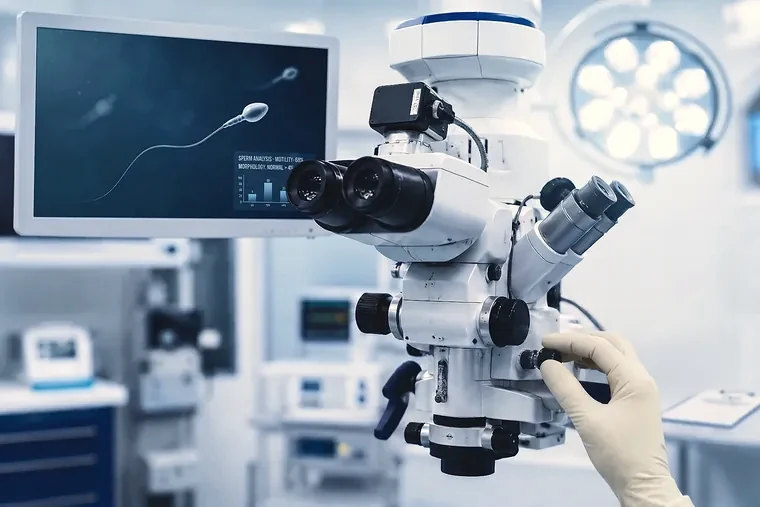
Even where no sperm appear in the ejaculate, sperm are often still being produced inside the testis. Micro-TESE uses an operating microscope to find the few tubules that are working — and a vasectomy done years ago can usually be reversed microsurgically, with patency and pregnancy being two very different numbers worth asking about separately.
The leaflets above are published by the British Association of Urological Surgeons (BAUS) and open in a new tab. They are linked, not hosted or altered.
Written and reviewed by Mr Musaab Yassin, Consultant Urological Surgeon & Andrologist. FRCS (Urol) · GMC 6118378 ·
Evidence Notes · Male fertility
Every device company publishes its best trial and every clinic quotes the most flattering figure from it. These are the appraisals that belong to this condition — two of the twelve — including the unflattering findings, and the places where good studies disagree with one another.
Male fertility
Close to 100% retrieval where the cause is a blockage; 40–60% with Micro-TESE where the testis is failing. The tests come first.
Read the note → No. 11 · Dna FragmentationVaricocele repair cuts fragmentation by 12.4% at six months. Antioxidants manage 3–4%, and are what most men have already bought.
Read the note →Common Questions · Male fertility
Short, referenced answers to the questions that come before a diagnosis exists — written to be read at eleven at night, by someone who has not told anyone yet. Each is referenced to guidelines, systematic reviews and trials, with the studies listed at the foot of its page.
Semen analysis, azoospermia, varicocele, and being investigated at all.
24% of clinicians never physically examine the male partner.
All fifty-five, across every condition, are on the practice page.
Before your visit
Complete the questionnaire before you come. Nothing is saved or transmitted — you print the summary or copy it into an email, and it stays entirely in your control.
How long you have been trying, previous results, surgical history, partner factors.
Open the questionnaire →Any previous scans or reports, a list of your current medication, and the completed questionnaire if you have had time.
The consultation itself takes at least twenty minutes. Allow up to an hour if you are having a flow test, a scan, bloods or a urine test on the day.
Partners are welcome throughout, and for fertility discussions it is often better if you both come.
The other areas
Booking, fees and the four ways to get in touch are on the practice page.