Nuffield Health The Manor Hospital, Oxford
Mr Musaab Yassin · Consultant Urological Surgeon & Andrologist
Being told there is no sperm in the ejaculate is not the end of the conversation. Microdissection testicular sperm extraction is how we find out whether any is still being made.
01 · Understanding micro-TESE
Azoospermia means no sperm can be found in the ejaculate. It used to end the conversation about biological fatherhood. It no longer does — because in most men the testicle has not stopped working everywhere at once.
There are two quite different reasons for an empty sample, and they lead to different operations. In obstructive azoospermia, sperm is being made normally but cannot get out — after a vasectomy, an infection, or a blockage present from birth. Retrieval there is comparatively straightforward, and reconstruction may be an option instead.
In non-obstructive azoospermia, production itself has failed. But it rarely fails everywhere: isolated pockets of active sperm production frequently survive within a wider landscape of failing tissue. They are microscopic, they are unevenly scattered, and a random biopsy will usually miss them.
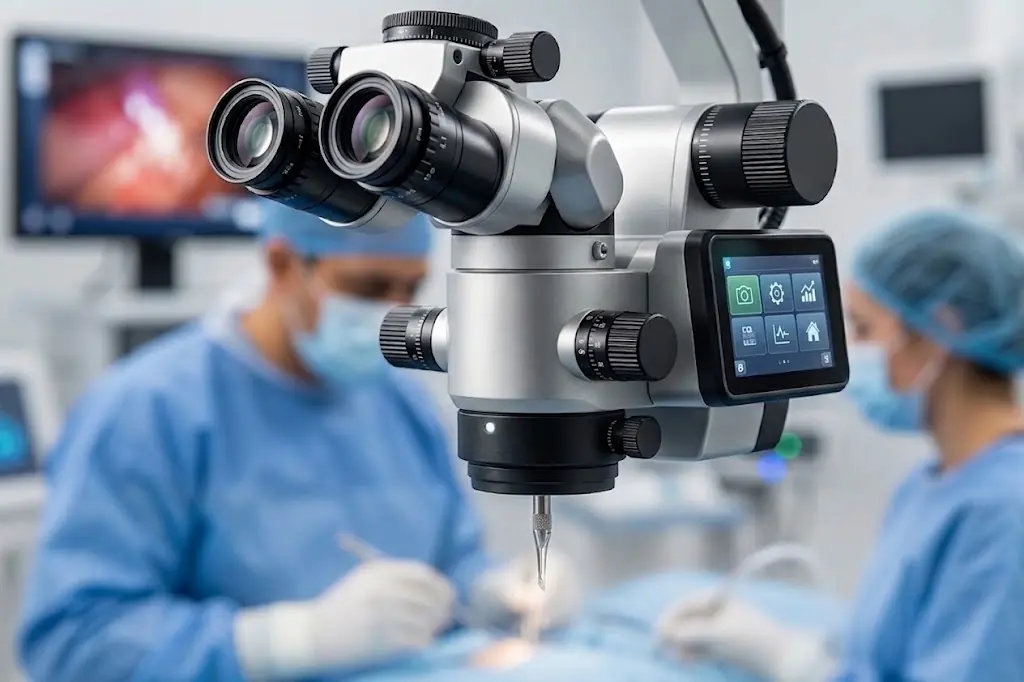
That is the entire premise of micro-TESE. Under a high-powered operating microscope at 20 to 40 times magnification, the seminiferous tubules can be examined directly. Tubules that are unusually dilated, opaque or pale are the ones likely to contain developing sperm; thin, translucent tubules are not. Only the promising ones are taken.
It is the difference between hunting and guessing — and it matters twice over. It finds sperm in men where blind biopsy fails, and because far less tissue is removed, it does less damage to the cells that make your testosterone.
Promising tubules are identified visually and taken individually, rather than sampling blindly and hoping.
Because only selected tubules are taken, the volume of testicular tissue removed is a fraction of that in a conventional biopsy.
Meta-analysis consistently shows higher sperm retrieval than conventional or blind TESE in non-obstructive azoospermia.
Tissue is examined in the adjoining laboratory in real time, so the search stops as soon as sperm is confirmed.
02 · What has to happen first
Micro-TESE is not the first step. Before it is offered, a small set of investigations establishes the cause — and in a few men, identifies a genetic result that makes retrieval almost impossible and the surgery inadvisable.
Why this matters more than it sounds
These are inexpensive blood tests that can spare a man a general anaesthetic and an operation with no realistic prospect of success — and, in the case of a Y microdeletion, give a couple information they will want before conceiving rather than after. If micro-TESE has been offered to you anywhere without a karyotype and Y microdeletion screen, ask why.
Across all men with non-obstructive azoospermia, micro-TESE retrieves usable sperm in roughly 40% to 60% of cases. That average is not very useful to any individual, because the underlying pattern in the testicle changes the odds substantially — and that pattern is often only known after the operation, or from a previous biopsy.
| Pattern | What it means | Retrieval |
|---|---|---|
| Hypospermatogenesis | Every stage of sperm development is present, but production volume is drastically reduced | 73% to over 90% |
| Maturation arrest | Development begins normally then halts before sperm mature | 27–36% |
| Sertoli cell-only | Only the supporting cells remain; germ cells appear absent | 22–44% |
Note the last row. Even where a diagnostic biopsy reported no germ cells at all, an exhaustive microscopic search still finds sperm in something between a fifth and nearly half of men. That is precisely the situation micro-TESE exists for.
03 · Timing with the IVF cycle
Any sperm retrieved must be used with ICSI, where a single sperm is injected directly into an egg. Testicular sperm have not matured through the epididymis and cannot fertilise an egg unaided, so conventional IVF is not an option. That means the operation has to be planned around your partner's cycle, and there are two ways to do it.
The retrieval is timed to your partner's egg collection, and anything found is used the same day. Nothing is frozen and thawed, which avoids any loss of the very small numbers involved.
The cost: if no sperm is found, your partner has already been through ovarian stimulation and egg collection for a cycle that cannot proceed with your sperm. That is a hard day, and it is the reason many couples choose the other route.
The operation happens on its own timetable and anything found is frozen. You know the answer before your partner starts any medication, and the IVF cycle is only begun if there is something to use.
The cost: freezing and thawing very small numbers of sperm carries some loss, and not every sample survives it well. Where only a handful of sperm are found, a fresh cycle may give a better chance.
There is no universally right answer — it depends on how much sperm we expect to find, your partner's age and ovarian reserve, and how you both feel about the possibility of a cancelled cycle. This is a conversation to have jointly with your fertility clinic well before a date is booked, and it is one of the main things I want to discuss at the consultation.
04 · Preparing for surgery
The rules below exist so that the operation is not delayed or cancelled on the day. The hospital will send its own pre-admission instructions; where they differ from anything here, follow theirs.
05 · Recovery
Swelling and a dull ache are expected. Almost every complication that happens after this operation is a bleed into the scrotum, and almost all of it is prevented by ice, support and doing nothing for 48 hours.
Bed rest, up only for the bathroom and meals. Ice pack — or frozen peas in a cloth, never directly on skin — for 15 to 20 minutes every two to three hours while awake. Supportive underwear day and night. Keep the wound completely dry.
Most men return to light desk work and gentle walking. Continue the supportive underwear day and night for one to two weeks. Nothing heavier than 5 kg, no strenuous exertion, no cycling. Quick warm showers are fine after the first 48 hours; pat the area dry rather than rubbing.
Dissolvable stitches disappear over two to three weeks. Continue avoiding baths, swimming pools, hot tubs and saunas until the wound is fully healed. No sexual activity or ejaculation for at least two weeks.
The incision should be healed. At your follow-up consultation we go through what was found, what the histology showed, and what it means for the next step — then clear you for full physical activity.
Because tissue is removed from the organ that makes your testosterone, levels can fall — typically by up to around 16%, and occasionally taking 18 to 24 months to recover. This is monitored with blood tests rather than left to chance, and treated if it does not recover.
Take pain relief regularly rather than waiting for the ache to become severe. Paracetamol is the first choice. Anti-inflammatories such as ibuprofen are effective but increase the tendency to bleed, and bleeding into the scrotum is the main complication of this operation — so take one only if your surgical team has specifically cleared you to. If paracetamol is not controlling the pain, ring us rather than adding something yourself.
06 · When to contact the clinic
Mild bruising, a dull ache, and a small amount of clear fluid or blood oozing from the incision are all part of healing. Contact the clinic straight away, or go to your nearest A&E out of hours, if any of the following happens.
The complication this operation is most likely to produce is a haematoma — a collection of blood inside the scrotum.
Pain in the scrotum or groin that is not relieved by the painkillers you have been given, or that is increasing rather than easing day by day.
Who to call
The clinical team will assess your symptoms and tell you what to do next.
Out of hours, do not wait. Go to your nearest Accident and Emergency department and tell the staff you have recently had testicular surgery. WhatsApp and email are not monitored out of hours and must not be used for anything urgent.
07 · Questions
Roughly 40% to 60% across all men with non-obstructive azoospermia — but the honest answer for you depends on the pattern inside the testicle, which ranges from over 90% where all stages of development are present to around a quarter where only supporting cells appear to remain. The table above sets those out.
Your hormone profile, testicular volume, genetic results and any previous biopsy all refine that estimate, and we will go through your own figures rather than the average at the consultation.
This is the question that matters most, and it deserves a straight answer rather than a reassuring one. If the embryologist confirms that no viable sperm can be located, the operation is concluded without taking further tissue unnecessarily. There is nothing to be gained from continuing.
It is a hard day. What it also does is end the uncertainty — you have a definitive answer rather than an open question, and that allows you and your partner to move to donor sperm or adoption as a considered decision rather than a defeat. Both are routes to fatherhood, and your fertility clinic will take that conversation forward with you. I would rather give you a clear answer than leave you wondering for another five years.
Pain, bruising and swelling are expected for the first few days and are managed with rest, ice, support and paracetamol.
Bleeding into the scrotum — a haematoma — is the main complication to watch for, which is why the first 48 hours are spent horizontal with an ice pack. Infection is uncommon and minimised by strict surgical technique.
Testosterone. Because testicular tissue is removed, levels can fall — typically by up to around 16%, and sometimes taking 18 to 24 months to return to baseline. In a small number of men it does not fully recover and replacement therapy is needed. The microsurgical technique exists partly to limit this: taking a fraction of the tissue a conventional biopsy would remove is what protects the cells that make your testosterone. Levels are checked afterwards rather than assumed.
This is why we tell you which pain to ignore and which to ring about. A dull ache that eases day by day, and bruising that spreads before it fades, are the ordinary course of things. Pain that is out of proportion to how the scrotum actually looks, and that escalates rather than settles over the first day or two, is not.
The reason for drawing that line is a complication called testicular compartment syndrome, where swelling inside the fibrous capsule of the testicle raises the pressure within it until the blood supply is choked off. It is genuinely rare — around fourteen cases have been reported in the entire literature, one of them after a bilateral micro-TESE — and it is here not to frighten you but because it is the one thing on this page where the timing of the phone call changes the outcome.
The treatment is surgical decompression, and it works when it is done early. That is why pain of that kind needs to be seen the same day rather than the next morning, and why the out-of-hours instruction is to go to A&E rather than wait for the clinic to open. If you are not sure whether what you are feeling counts, ring and let us make that call.
No. Sperm taken directly from the testicle has not matured through the epididymis and cannot fertilise an egg on its own, so it must be used with ICSI — where a single sperm is injected directly into the egg. That is not a limitation of this operation; it is true of all surgically retrieved sperm.
There is one incidental advantage worth knowing: testicular sperm carries substantially less DNA damage than ejaculated sperm from the same man, because much of that damage happens after production, during storage and transit.
Medical treatment first. Where the hormone profile suggests a treatable cause, a course of medical therapy before surgery can improve the odds — and occasionally produces sperm in the ejaculate, avoiding an operation altogether. That is established at the assessment.
Conventional TESE or TESA. Older techniques that sample without a microscope. They remove more tissue and find sperm less often in non-obstructive azoospermia, which is why micro-TESE is preferred where production failure is the problem. Where the cause is obstruction rather than production, simpler retrieval — or surgical reconstruction — may be the better answer.
Donor sperm. A successful and well-established route to fatherhood, coordinated through your fertility clinic. Raising it is not giving up; having it in view from the beginning is part of making a considered decision.
The operation does not affect erections or the mechanics of ejaculation. Abstain from sexual activity for at least two weeks while the tissue heals, then resume normally. If testosterone falls significantly afterwards it can affect libido and energy, which is a further reason levels are monitored.
It changes one laboratory measurement, and that is worth explaining rather than hiding. The DNA fragmentation index — the proportion of sperm carrying broken DNA strands — does rise across a freeze and thaw. In one study it went from around 25% before freezing to around 40% after thawing. On its own, that number sounds alarming.
The measurement and the outcome are not the same thing. Where fresh testicular sperm has been compared directly with frozen and thawed testicular sperm, the comparisons have not found a difference in fertilisation, embryo quality or live birth. Testicular sperm also starts with less DNA damage than ejaculated sperm from the same man, which is part of why it is used at all.
Both of those can be true because of how ICSI works. A single sperm is selected and injected rather than a population competing, and the egg itself has some capacity to repair damaged sperm DNA. A rise in an average taken across thousands of sperm does not necessarily describe the one that is used.
The caveat is that this is a much smaller body of evidence than the retrieval-rate literature, and one of the supporting sources is a conference abstract rather than a full paper. What it does support is where to put your worry. The freeze is not the thing to be anxious about; whether sperm is found at all, and your partner's age and ovarian reserve, matter far more.
That depends on whether the plan is a synchronised retrieval or retrieval and freezing — see the section above. Where sperm is frozen, the cycle can begin once you have recovered and the laboratory has confirmed what is stored. Where it is synchronised, the two are booked together from the outset, with your fertility clinic.
Taking the next step
Two semen analyses, a hormone profile, a karyotype and a Y-chromosome microdeletion screen — then a frank conversation about what your own odds actually are, and how the operation would fit around your partner's cycle. If the tests suggest surgery is not the right answer for you, I will tell you so.
WhatsApp is for appointments and practical questions. Please do not send clinical details or images through it.