Nuffield Health The Manor Hospital, Oxford
Mr Musaab Yassin · Consultant Urological Surgeon & Andrologist
Reconnecting the vas deferens under an operating microscope, with sutures finer than a human hair — and an honest account of what the numbers actually mean.
01 · Understanding the operation
A vasectomy divides the vas deferens — the tube carrying sperm from the testicle. A reversal rejoins it. The difficulty is that the channel running through the middle of that tube is around a third of a millimetre across, and it has to be rejoined watertight, or scar tissue simply seals it again.
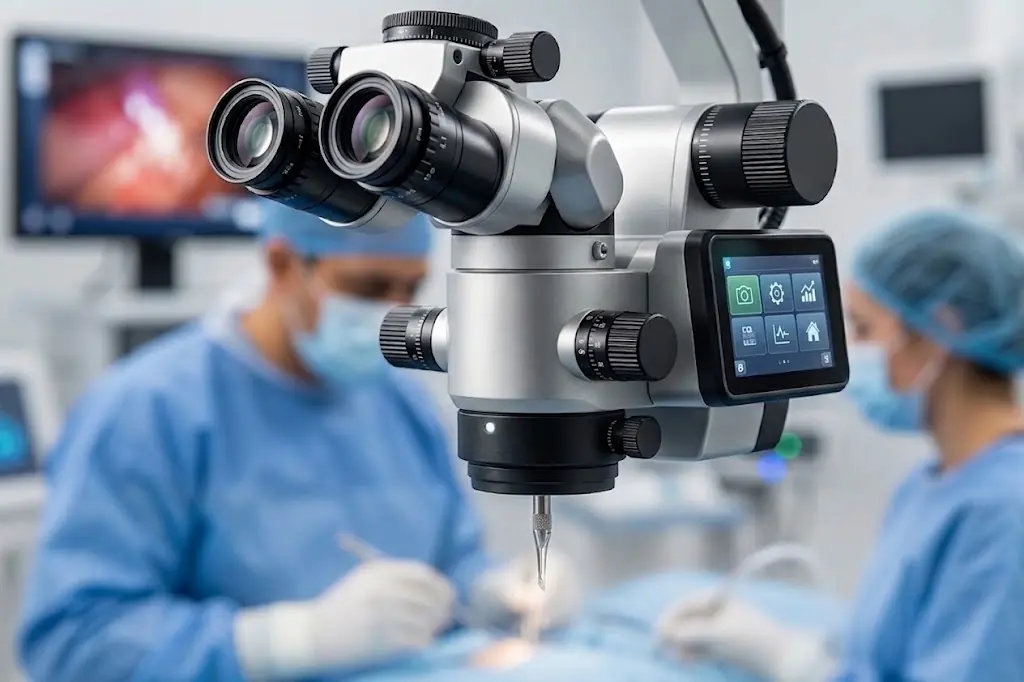
That is why this is done microsurgically rather than with the naked eye. Under high magnification the inner lining can be aligned precisely and stitched with sutures finer than a human hair — a technique that produces substantially better results than a macroscopic repair, and is the reason the operation is a genuine speciality rather than a general one.
Consent for both, always
You will not know which operation you have had until you wake up. Roughly speaking, the longer it is since the vasectomy, the more likely a vasoepididymostomy becomes — pressure builds behind the block over the years and can rupture the epididymal tubule. Any surgeon offering reversal must be able to perform both, and must have consented you for both, because discovering the need mid-operation and being unable to do it wastes the anaesthetic and the opportunity.
If sperm is seen in the fluid during the operation, it can be collected and frozen at the same time as a backup. It costs you nothing extra in surgery or recovery, and it means that if the reversal does not work you still have material for ICSI without a second operation. Worth deciding in advance with your fertility clinic, since storage has to be arranged beforehand and is regulated by the HFEA.
02 · Your odds, honestly
This is the most important thing on the page, and the place where reversal is most often oversold. There are two separate measures of success, and quoting only the first one is misleading.
| Years since vasectomy | Sperm return | Pregnancy |
|---|---|---|
| Under 3 years | ~97% | ~76% |
| 3 to 8 years | ~88% | ~53% |
| 9 to 14 years | ~79% | ~44% |
| 15 years or more | ~71% | ~30% |
Two things follow from that table. First, sperm returns in most men even after fifteen years — the tube can almost always be rejoined. Second, the pregnancy rate falls much faster than the patency rate, and by fifteen years fewer than a third of couples conceive. Both numbers are real; quoting only the left-hand column is how expectations get set wrongly.
Where a vasoepididymostomy is needed rather than a direct rejoin, patency falls to roughly 60–70% and pregnancy to around 30–40%. It also takes longer to work: sperm may not appear for three to twelve months, so an early negative test is not a failure.
The factor that outweighs everything above
Your partner's age and fertility. No table of male outcomes means much without it. A reversal with an 88% chance of sperm returning delivers a very different real-world result if your partner is 32 than if she is 42, and the published pregnancy figures largely reflect couples with younger female partners. If your partner is over 37, or has any known fertility issue of her own, she should be assessed before you book this operation — not afterwards. It sometimes changes the recommendation entirely.

03 · The real choice
These are the two routes to a biological child after a vasectomy, and the right one depends on the interval, your partner's age and fertility, how many children you hope for, and how you feel about IVF.
One operation for you, none for your partner. If it works you can conceive naturally, repeatedly, over years — a second or third child needs nothing further. No IVF cycles, no drugs for your partner, and no per-attempt cost.
The cost: it may not work, you will not know for weeks or months, and the odds fall with the interval since your vasectomy. If your partner's fertility is time-limited, the waiting itself is a real cost.
Sperm is taken directly from the testicle or epididymis and used to fertilise eggs in the laboratory. It bypasses the blockage entirely, so the interval since your vasectomy barely matters, and the answer comes within one cycle.
The cost: your partner undergoes ovarian stimulation and egg collection, with everything that involves. Each attempt at another child needs another cycle, and IVF success is itself strongly determined by her age.
As a rough guide: a short interval, a younger partner and a wish for more than one child point towards reversal. A long interval, an older partner, a known female factor, or a need for an answer quickly point towards retrieval and ICSI. Many couples are somewhere in between, which is what the consultation is for — and freezing sperm during the reversal keeps both doors open.
04 · Preparing for surgery
The hospital will send its own pre-admission instructions; where they differ from anything here, follow theirs.
05 · Recovery
Two things determine how this heals: keeping the scrotum supported and still for the first 48 hours, and not ejaculating for three to four weeks. The second is the one men underestimate.
Bed rest, up only for the bathroom and meals. Ice pack — or frozen peas in a cloth, never directly on skin — for 15 to 20 minutes every two to three hours while awake. Supportive underwear day and night. Keep the incisions completely dry.
Quick warm showers are fine after the first 48 hours; pat dry rather than rubbing. No baths, pools, hot tubs or saunas until fully healed. Most men return to desk work after about a week. Nothing heavier than 5 kg, no strenuous exercise, no cycling.
This is the part that matters most and the part most often ignored. Ejaculating before the microscopic join has healed can disrupt it, and there is no way to repair that except another operation. Three to four weeks, strictly — including on your own.
The only way to know whether the operation has worked. Preparation for it matters — see the next section — and a first result is a starting point rather than a verdict.
Particularly after a vasoepididymostomy, sperm may take three to twelve months to appear. Testing is repeated at intervals rather than judged on one sample, and counts often rise over the first year. Equally, sperm that returns can later disappear if the join scars down, which is another reason for repeat testing.
Take pain relief regularly rather than waiting for the ache to become severe. Paracetamol is the first choice. Anti-inflammatories such as ibuprofen work well but increase the tendency to bleed, and bleeding into the scrotum is the main complication of scrotal surgery — take one only if your surgical team has specifically cleared you to. If paracetamol is not controlling the pain, ring us rather than adding something yourself.
06 · The semen analysis
A formal laboratory analysis is the only way to confirm the operation has worked. Several things that feel trivial will materially alter what the laboratory sees, so the preparation is worth getting right.
Why this differs from advice you may have read elsewhere
For men trying to conceive, ejaculating every one to three days is better, because shorter intervals mean less DNA damage. That advice is about optimising conception. The two-to-seven-day window here is a diagnostic standard, used so that results are consistent and comparable between samples and between laboratories. Follow the diagnostic rule for the test, and the shorter interval the rest of the time.
The laboratory report arrives as a column of numbers with reference values beside them, and it is easy to read a single figure below the line as a verdict. It is not. Here is what each measure means, and how much weight it carries after a reversal.
| Measure | Lower limit | What it tells you |
|---|---|---|
| Concentration | 16 million/mL | How many sperm per millilitre. After a reversal this is the number that climbs slowly — counts often keep rising for six to twelve months as flow re-establishes. |
| Total motility | 42% | The proportion moving at all. A marker of vitality. |
| Progressive motility | 30% | The proportion swimming purposefully forward. More important than total motility, because only this kind of movement gets anywhere. |
| Morphology | 4% | The proportion of perfectly formed sperm. Four per cent sounds alarming until you know that abnormal forms are normal — the great majority are imperfect in every fertile man. |
| Volume | 1.4 mL | Total fluid produced. Mostly reflects the seminal vesicles and prostate rather than the testicles. |
| Vitality | 54% live | Run when motility is unexpectedly low, to distinguish sperm that are dead from sperm that are alive but not swimming. The two have different implications. |
Three things worth knowing before you read your own report
These are decision limits, not a pass mark. They come from the fifth percentile of men whose partners conceived within a year — meaning one in twenty fertile men falls below each of them. Men below conceive naturally; men above sometimes do not.
One sample is not a result. Semen parameters vary substantially week to week with illness, stress and abstinence interval. Conclusions are drawn from at least two samples, taken weeks apart.
After a reversal, early numbers understate the outcome. Sperm returning at all is the primary success. Concentration and motility typically improve over the following months, and after a vasoepididymostomy they may not appear for three to twelve months — which is why testing is repeated rather than judged once.
What matters at the follow-up is not any single figure but the pattern across samples, read alongside the interval since your vasectomy, what was found during the operation, and your partner's assessment. We go through the report together rather than emailing you a number.
07 · When to contact the clinic
Mild bruising, a dull ache, and a little clear fluid or blood oozing from the incisions are part of healing. Contact the clinic straight away, or go to your nearest A&E out of hours, if any of the following happens.
A haematoma — bleeding into the scrotum — is the complication this operation is most likely to produce, and it is why the first 48 hours are spent lying down with an ice pack.
Pain in the scrotum or groin not relieved by your painkillers, or increasing rather than easing day by day.
Who to call
The clinical team will assess your symptoms and tell you what to do next.
Out of hours, do not wait. Go to your nearest Accident and Emergency department and tell the staff you have recently had scrotal surgery. WhatsApp and email are not monitored out of hours and must not be used for anything urgent.
08 · Questions
No absolute cut-off. Sperm returns in roughly seven out of ten men even beyond fifteen years, and successful reversals have been done after twenty-five. What changes is the pregnancy rate, which falls considerably, and the likelihood of needing the more complex epididymal join.
So the question is not whether it is possible but whether it is the best use of your time and money compared with retrieval and ICSI — and that depends as much on your partner as on you.
That it does not work. The commonest disappointment is not a complication but a failure to restore fertility, usually because of scarring or a second blockage further back. That risk is quantified in the table above rather than glossed over.
Bleeding into the scrotum, which is why the first two days are spent resting with ice and support. Infection, uncommon and usually resolved with antibiotics. Late failure, where sperm returns and then disappears as the join scars — another reason for repeat testing.
Chronic scrotal pain is rare but real, and worth knowing about before rather than after. It is one of the reasons a reversal should not be undertaken lightly by a man who is not certain he wants more children.
Not knowable until the fluid from the testicular end is examined during the operation. If it contains sperm or is clear and copious, a direct vas-to-vas rejoin is appropriate. If it is thick, pasty and sperm-free, the blockage extends back into the epididymis and a vasoepididymostomy is needed.
The longer since your vasectomy, the more likely the second. You are consented for both, and the decision is made in theatre on what is actually found.
If sperm is seen in the fluid during the operation, it can be collected and frozen with no additional surgery. It is a reasonable insurance policy: if the reversal fails, you have material for ICSI without a second procedure and a second anaesthetic.
Storage in the UK is regulated by the HFEA and has to be arranged in advance with a licensed centre, including consent paperwork and storage fees, so decide before the operation rather than on the day.
Sexual activity resumes after three to four weeks. Whether it is worth trying immediately depends on the first semen analysis at six to eight weeks — but there is no reason to wait for the result before resuming a normal sex life.
No. The operation is on the tube carrying sperm, not on the testicle's hormone-producing tissue, and it does not touch the nerves involved in erection or the mechanics of orgasm. What changes is that the ejaculate contains sperm again — which is the entire point.
A repeat reversal is sometimes possible and can succeed, particularly where the first was not performed microsurgically. More often the sensible next step is surgical sperm retrieval with ICSI, which bypasses the blockage entirely — and if sperm was frozen during your reversal, that route is already open without further surgery.
Either way you will have a definitive answer rather than an open question, which is worth something on its own.
Taking the next step
This is a decision about a couple, not about one man's plumbing. The assessment covers the interval since your vasectomy, examination, your partner's age and fertility, and a frank comparison between reversal and retrieval with ICSI — so that whichever you choose, you chose it knowing both sets of numbers.
WhatsApp is for appointments and practical questions. Please do not send clinical details or images through it.