Rezūm is a minimally invasive treatment for an enlarged prostate, or benign prostatic hyperplasia (BPH). It delivers small amounts of water vapour into the prostate, causing the treated tissue to shrink over the following weeks and months.
Its main attraction is the possibility of improving urinary symptoms without removing prostate tissue surgically—and with a relatively low risk of affecting erections or ejaculation.
The evidence is encouraging, but Rezūm is not simply a smaller version of prostate surgery. Improvement is usually slower and, on average, less pronounced than after operations such as transurethral resection of the prostate (TURP) or holmium laser enucleation of the prostate (HoLEP). A temporary catheter is often needed, urinary symptoms can worsen before they improve, and some men eventually require another treatment.
So, what does the science actually show?
Rezūm: the evidence at a glance
| Outcome | What the evidence suggests |
|---|---|
| Urinary symptoms | The pivotal trial reported a 48% reduction in IPSS at five years.1 |
| Urinary flow | Maximum flow improved by 44% at five years in the pivotal trial.1 |
| Speed | Improvement may begin within a month, but a clearer benefit usually develops over three to six months.2 |
| Surgical retreatment | 4.4% at five years in the pivotal study; other studies report different rates because populations and definitions vary.1 |
| Erections | New erectile dysfunction has been uncommon in published studies, but it cannot be ruled out for an individual patient.2 |
| Ejaculation | Usually preserved, although reduced volume, discomfort or loss of forward ejaculation can occur.3 |
| Best-established prostate size | The strongest randomised evidence is for prostates measuring 30–80 mL.1 |
These are study averages, not guarantees for an individual patient.
What is Rezūm?
Rezūm is a treatment for urinary symptoms caused by non-cancerous prostate enlargement.
The prostate sits beneath the bladder and surrounds the urethra—the tube that carries urine out of the body. As the prostate enlarges, it can squeeze the urethra and obstruct urine flow.
This may cause:
- a weak stream
- difficulty starting urination
- stopping and starting
- a feeling that the bladder has not emptied
- urgency and frequency
- getting up repeatedly at night
- and, in some men, complete urinary retention.
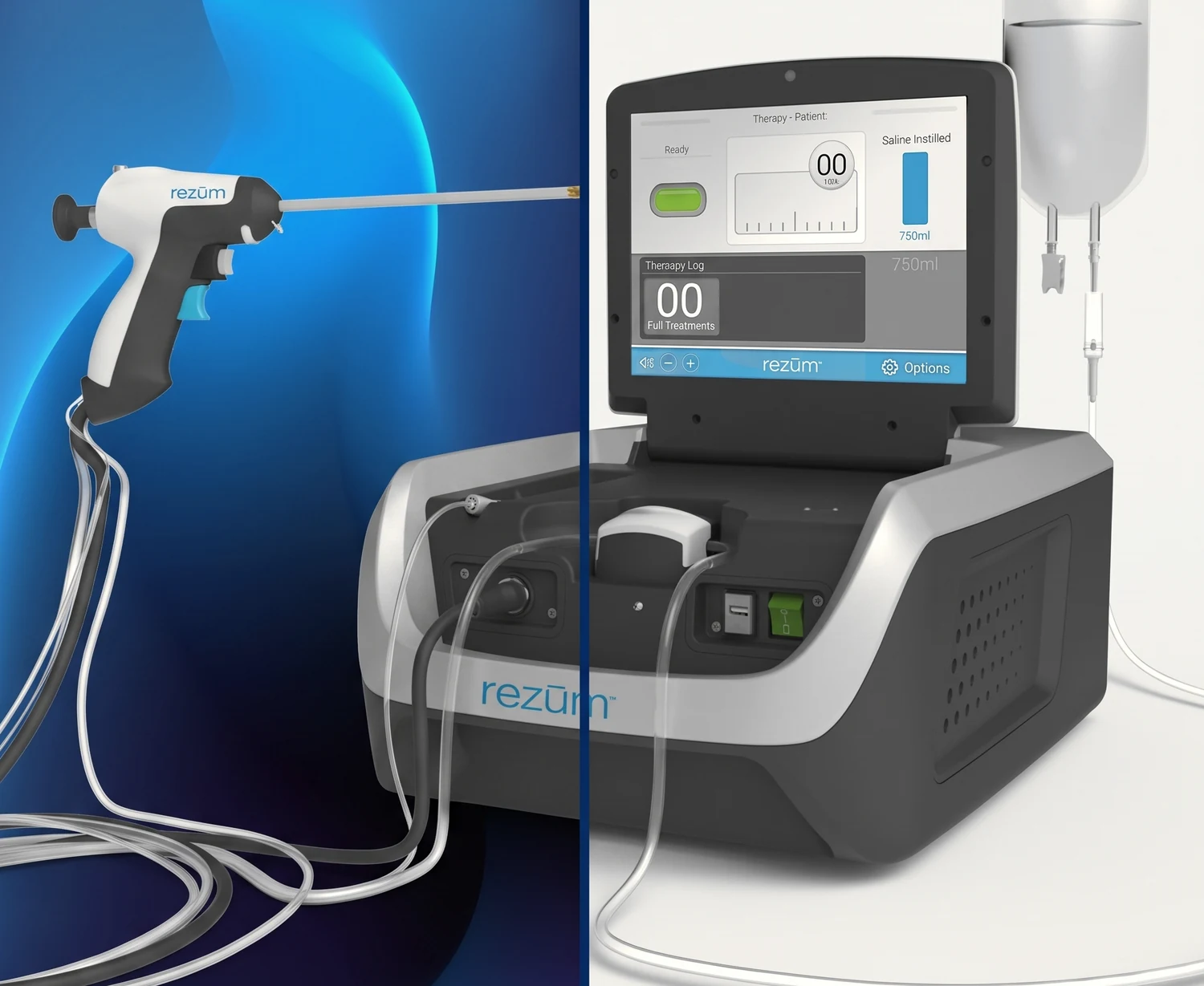
Rezūm is performed through the urethra, so there is no cut in the skin. A narrow instrument is passed into the prostate and small injections of sterile water vapour are delivered into selected areas of enlarged tissue.
The procedure can often be performed as a day case under local anaesthetic, sedation or a short general anaesthetic, depending on the patient, centre and treatment plan.
How does Rezūm work?
The device uses radiofrequency energy to turn water into vapour. When that vapour enters the cooler prostate tissue, it condenses back into water and releases stored heat.
This controlled thermal energy damages the targeted prostate cells. Over the following weeks and months, the body gradually clears the treated tissue. The obstructing part of the prostate becomes smaller and the urethra opens more freely.4
Each vapour injection lasts only a few seconds. The number and position of injections depend on the size and shape of the prostate, including whether there is an enlarged median lobe—tissue growing upwards towards the bladder.
Unlike TURP or HoLEP, Rezūm does not immediately cut out or shell out the obstructing tissue. That explains two important features:
- improvement develops gradually rather than immediately
- swelling and inflammation can temporarily make symptoms worse before they get better.
Does Rezūm actually work?
For appropriately selected men, the evidence indicates that Rezūm can produce a meaningful and durable improvement in urinary symptoms.
The strongest evidence comes from a multicentre randomised controlled trial involving 197 men with moderate-to-severe symptoms, reduced urinary flow and prostates measuring 30–80 mL. Participants were initially assigned to Rezūm or a sham procedure, allowing researchers to distinguish a genuine treatment effect from a placebo effect during the first three months.5
At three months, the average International Prostate Symptom Score (IPSS) fell by:
- 11.2 points after Rezūm
- 4.3 points after the sham procedure.5
The control group was then allowed to cross over to active treatment, so the five-year results are long-term follow-up of the treated group—not a five-year comparison with an untreated or sham group.
Among the men followed after Rezūm, the five-year study reported:
- 48% improvement in IPSS
- 45% improvement in quality of life
- 44% improvement in maximum urinary flow
- 48% improvement in the BPH Impact Index, another questionnaire measuring how troublesome symptoms are.1
A systematic review of 19 studies and 1,942 patients reached a similar overall conclusion. At three months, the median improvement across studies was approximately:
- 51% in IPSS
- 51% in quality of life
- 66% in maximum urinary flow.2
The exact result varied between studies. These percentages should therefore be treated as a useful description of the average evidence—not as a prediction of what every patient will experience.
Symptom score, against sham
−4.3→−11.2IPSS points at 3 months
The pivotal trial randomised 197 men to Rezūm or a sham procedure. The sham arm is what separates a real effect from the effect of having had something done.
Symptom improvement held
48%at five years
Same programme, treated men followed to five years.
Another BPH operation needed
4.4%by five years
Pivotal population. Broader real-world groups report more.
Where the randomisation stops The sham comparison ended at three months, when the control group was allowed to cross over. Everything after that is long-term follow-up of treated men — reassuring, but not five years of randomised comparison.
What does an IPSS improvement mean?
The International Prostate Symptom Score is a seven-question assessment of urinary symptoms. It covers frequency, urgency, weak stream, stopping and starting, straining, incomplete emptying and getting up at night.
The total score ranges from 0 to 35:
- 0–7: mild symptoms
- 8–19: moderate symptoms
- 20–35: severe symptoms.
Patients can usually notice an improvement of around three points. A fall of approximately 10–11 points, as seen in the pivotal Rezūm trial, is therefore a substantial average change.
However, IPSS is a symptom score rather than a direct measurement of obstruction. A patient may feel considerably better even if the increase in measured urinary flow is relatively modest—and the reverse can also occur.
How much does urinary flow improve?
The pivotal randomised trial reported that maximum urinary flow, known as Qmax, increased by approximately 6.4 mL/second at three months.5
At five years, the improvement was approximately 4.3 mL/second, equivalent to a 44% increase from baseline.1
The 2022 systematic review also found consistent improvements in Qmax across different studies, with a median improvement of 66% at three months.2
That is clinically useful, but the increase in flow is generally smaller than the improvement produced by procedures that remove more tissue, such as TURP or HoLEP.
Urinary flow also depends on the strength of the bladder muscle. If the bladder has become weak after years of obstruction, opening the prostate may not restore a completely normal stream.
How quickly does Rezūm work?
Rezūm is not an instant treatment.
Some men notice improvement within several weeks, and systematic-review evidence suggests that average symptom and flow improvements can be detected from approximately one month.2
The benefit usually becomes clearer over three to six months as the treated tissue shrinks. Improvement may continue beyond that point.
During the first days or weeks, inflammation can cause:
- increased frequency or urgency
- burning or stinging
- blood in the urine or semen
- a weaker stream
- temporary difficulty passing urine.
Many patients leave with a urinary catheter. The duration varies with prostate size, swelling, pre-existing retention and local practice, but several days is common. Men treated while already dependent on a catheter often need a longer period before a successful trial without it.
This slower recovery of urinary function is an important practical difference between Rezūm and operations that physically remove the obstruction during the procedure.
The obstruction is not removed on the day. Steam kills the tissue; your immune system clears it over weeks. Symptoms often get worse before they get better, and a catheter is common.
How durable are the results?
The pivotal study provides reassuring evidence to five years.
Improvements in symptoms, quality of life and urinary flow were maintained through five-year follow-up, with IPSS remaining 48% below baseline and Qmax 44% above baseline.1
This is meaningful long-term evidence for a minimally invasive BPH treatment.
There are, however, two important qualifications.
First, the sham-controlled comparison ended after three months. The later results show that benefits persisted among treated patients, but they are not the same as five years of randomised comparison against another active treatment.
Second, five-year evidence should not be confused with lifetime evidence. TURP and HoLEP have a much longer clinical history and more data extending beyond ten years.
Rezūm's very long-term durability beyond five years is therefore still being established.
What is the retreatment rate?
The most frequently quoted figure is a 4.4% surgical retreatment rate at five years from the pivotal trial.1
In other words, approximately 96% of men in that study had not required another BPH operation by five years.
This is encouraging, but it is not a universal figure. A systematic review reported five-year surgical retreatment rates ranging from approximately 4.4% to 7.5% across the available studies.2
A real-world series of 461 patients found that 21 men, or 4.6%, underwent another procedure during a mean follow-up of 16.7 months; 11 of those retreatments occurred during the first year. Common findings at reoperation included an inadequately treated median lobe or an obstructing bladder neck.6
Another real-life cohort reported a considerably higher 23% overall retreatment rate at two years, but this broader definition included restarting BPH medication as well as another operation.7
These figures are not directly contradictory. “Retreatment” can mean:
- another operation only
- another procedure of any kind
- restarting medication
- or a combination of medication and surgery.
The population also matters. Results from a tightly selected clinical trial may not fully reflect men with larger prostates, catheters, bladder problems or more complex anatomy in everyday practice.
The fairest conclusion is that surgical retreatment is uncommon over five years in the pivotal population, but the need for further treatment is not zero and may be higher in broader real-world groups.
Why the retreatment figures disagree 4.4% in the pivotal trial, 4.6% in a 461-patient real-world series, 23% in a two-year cohort that counted restarting medication as retreatment. The definitions differ, and so do the patients. Ask which definition any quoted figure is using.
What are the risks and complications?
Most reported complications after Rezūm are temporary and classified as Clavien–Dindo grade I or II, meaning they settle with observation, medication, a catheter or another relatively minor intervention.
A 2025 systematic review of 16 studies reported wide ranges because studies differed in how actively they recorded symptoms and which patients they treated. Reported complications included:
- blood in the urine: 1.7–71.7%
- burning or pain when passing urine: 1.8–64.5%
- urinary frequency or urgency: 3.2–50%
- temporary urinary retention: 4.4–33.8%
- urinary infection: 2–20%.3
Those broad ranges do not mean that the highest figure is a typical personal risk. They show how much the reported rate changes with study design, definitions, catheter use, prostate size and follow-up.
Potential risks include:
- urinary pain, urgency or frequency during healing
- blood in the urine or semen
- urinary infection
- temporary inability to pass urine
- a longer-than-expected need for a catheter
- pelvic discomfort
- reduced ejaculatory volume or altered ejaculation
- urethral or bladder-neck scar tissue
- persistent symptoms or the need for another treatment.
Serious complications have been uncommon in published studies, but they can occur. In an Italian multicentre series of 352 men, early complications were common but all were grade I or II apart from one patient with clot retention and bleeding who required a transfusion.8
Individual risk may be affected by prostate size, urinary retention, infection risk, blood-thinning medication and the experience of the treating team.
What happens to erections?
The evidence is generally reassuring.
The five-year pivotal study reported no sustained new erectile dysfunction attributable to the device or procedure.1 Across the 19 studies included in the 2022 systematic review, reported new erectile dysfunction ranged from 0% to 3.1%.2
A separate five-year analysis of sexual outcomes from the pivotal trial found no clinically meaningful deterioration in erectile-function scores among men who were sexually active at baseline.9
That analysis was conducted after the trial and patient numbers declined over time, so it is less definitive than a trial designed primarily around sexual function. It also does not prove that no individual will experience a change.
A balanced interpretation is:
Rezūm has a relatively low observed risk of causing new erectile dysfunction, but preservation of erections cannot be guaranteed.
What happens to ejaculation?
Forward—or antegrade—ejaculation is usually preserved after Rezūm, which is one of the treatment's principal attractions.
The pivotal five-year study reported no procedure-related sexual dysfunction overall.1 In the five-year sexual-function analysis, ejaculatory scores did not show a clinically important average deterioration.9
However, “sexual function preserved” does not mean that ejaculation is always completely unchanged.
Some men report:
- reduced semen volume
- discomfort during ejaculation
- temporary blood in the semen
- reduced force or altered sensation
- dry or retrograde ejaculation, where semen travels backwards into the bladder.
In a prospective registry of men with prostates of at least 80 mL, 3.6% reported reduced or absent ejaculation at 12 months.10 Rates vary between studies because researchers use different questionnaires and definitions.
Overall, normal forward ejaculation is considerably more likely to be retained after Rezūm than after conventional TURP or HoLEP, but it is not guaranteed.
What prostate sizes are suitable?
Prostates measuring 30–80 mL: strongest evidence
The pivotal randomised trial enrolled men with prostate volumes between 30 and 80 mL.1
This is therefore the range in which the effectiveness, five-year durability and retreatment rate are most securely established.
Prostates larger than 80 mL: promising but weaker evidence
Rezūm is increasingly used in larger prostates, but this extends beyond the original pivotal trial population.
A prospective registry followed 83 men with prostates of at least 80 mL; the median prostate volume was 100 mL, and 65% had a median lobe. At 12 months:
- IPSS had improved by 59%
- Qmax had improved by 59%
- quality of life had improved by 70%.
There were no grade III or higher complications, although catheterisation lasted a median of nine days.10
These results are encouraging, but the study was a single-arm registry with only 12 months of follow-up. It does not provide the same level of certainty as a large randomised trial.
An expert consensus published in 2025 considered men with prostates above 80 mL potential candidates, while acknowledging that the supporting evidence is less robust.11
For a very large prostate, the possibility of prolonged catheterisation, incomplete treatment and later retreatment must be weighed against more tissue-removing procedures such as HoLEP.
Can Rezūm treat a median lobe?
Yes. Rezūm can be directed into an enlarged median lobe as well as the two lateral lobes of the prostate.
The pivotal trial allowed treatment of the middle lobe according to the patient's anatomy, and the five-year report found benefit across the treated population.1 Larger-prostate observational studies have also included substantial numbers of men with median lobes.10
Correctly identifying and treating obstructing median-lobe tissue appears important. In the 461-patient real-world series, an inadequately treated median lobe was one of the findings seen in men who later required another procedure.6
A median lobe is therefore not automatically a reason to exclude Rezūm, but it makes careful cystoscopic or imaging assessment and appropriate treatment planning particularly important.
Can Rezūm help men who already have a catheter?
It may, although the evidence is mainly observational rather than randomised.
A systematic review of six studies involving 301 catheter-dependent patients found that approximately 85% passed a trial without a catheter after Rezūm. Reported complications were usually mild and self-limiting.12
Success was not immediate for everyone. In a separate Canadian series of 53 catheter-dependent men, 79% were catheter-free by a mean follow-up of 10.2 months, but almost half failed their first trial without a catheter at two weeks.13
This distinction matters. Rezūm can allow many catheter-dependent men to urinate independently, but the catheter may need to remain in place or be replaced while swelling settles and the tissue shrinks.
Outcome also depends on why the patient is in retention. A weak or damaged bladder muscle may prevent successful urination even if the prostate obstruction improves.
How does Rezūm compare with medication?
Medicines such as alpha blockers and 5-alpha-reductase inhibitors remain common first treatments for BPH.
Medication avoids a procedure and may be sufficient for mild or moderate symptoms. However, it must usually be taken continuously, may not provide enough relief and can cause dizziness, tiredness, reduced libido, erectile problems or ejaculatory changes depending on the drug.
Rezūm aims to provide a longer-lasting mechanical improvement without daily BPH medication. It involves a procedure, healing time, catheter risk and the possibility of retreatment.
The most suitable choice depends on symptom severity, prostate size, complications of obstruction and how a patient weighs ongoing medication against a one-off intervention. The current Rezūm evidence base is stronger for comparisons with sham treatment than for direct long-term comparisons with every medication strategy.
How does Rezūm compare with TURP?
TURP—transurethral resection of the prostate—removes obstructing prostate tissue through the urethra and has traditionally been a benchmark operation for BPH.
A randomised study of 100 men with prostates of 50–120 g compared Rezūm with bipolar TURP over two years. Rezūm produced meaningful improvement:
- IPSS improved by 55.3%
- quality of life improved by 50%
- Qmax improved by 62.5%
- residual urine fell by 50%.14
TURP produced greater improvements in urinary measures. Rezūm, however, involved a shorter operation and hospital stay, fewer complications and better preservation of erectile and ejaculatory function.14
This trial provides useful direct evidence, but it was a single-centre study with 50 patients in each group. Its findings are less secure than those of a large multicentre comparison.
The practical trade-off is broadly:
- TURP: faster and generally greater removal of obstruction, with stronger long-term surgical evidence, but a greater impact on ejaculation and a more substantial perioperative recovery.
- Rezūm: less invasive and more likely to preserve ejaculation, but slower to work and likely to produce a smaller average improvement in flow.
How does Rezūm compare with HoLEP and other enucleation procedures?
HoLEP—holmium laser enucleation of the prostate—shells out most of the enlarged inner prostate. It can be used across a very wide range of prostate sizes and has strong long-term durability.
A 2025 retrospective propensity-matched study compared 131 Rezūm patients with 131 HoLEP patients. At 12 months, HoLEP produced better average urinary outcomes:
- Qmax: 22.1 mL/second after HoLEP versus 16.8 after Rezūm
- IPSS: 7.1 after HoLEP versus 12.1 after Rezūm
- residual urine: 29.7 mL after HoLEP versus 43.1 after Rezūm.15
Rezūm had a much shorter operating time and shorter hospital stay, but a longer period of catheterisation. Preservation of forward ejaculation favoured Rezūm.15
Because this study was retrospective rather than randomised, unmeasured differences between the groups may have influenced the results.
A prospective, non-randomised study in prostates of at least 80 mL compared Rezūm with thulium laser enucleation. Symptom scores statistically favoured enucleation, although the difference did not reach the study's threshold for a clinically important difference. Ejaculatory function favoured Rezūm.16
Overall, enucleation is likely to provide greater and faster removal of obstruction with more established very long-term durability. Rezūm is less invasive and much more likely to preserve normal ejaculation, but requires patience during recovery and may carry a greater risk of residual obstruction or future retreatment.
Choose Rezūm for
Keeping what you have
- A short day-case treatment, often without a general anaesthetic
- Forward ejaculation preserved in the large majority
- No new erectile dysfunction in five-year follow-up
- Median-lobe tissue can be treated
The cost: slower improvement, a catheter, less de-obstruction, and a greater chance of needing something else later.
Choose enucleation for
Getting it dealt with
- Qmax 22.1 versus 16.8 mL/second at 12 months, matched patients
- IPSS 7.1 versus 12.1 in the same comparison
- Immediate relief of the blockage
- Durability measured in decades, not years
The cost: forward ejaculation, in the large majority.
How does Rezūm compare with UroLift, Aquablation and iTind?
Direct head-to-head evidence is limited.
A network meta-analysis used separate randomised trials to compare Rezūm, UroLift, Aquablation and TURP indirectly. The tissue-removing procedures—Aquablation and TURP—generally produced larger urinary improvements than Rezūm and UroLift. No clear difference between Rezūm and UroLift was demonstrated for urinary or sexual outcomes at 24 months.17
Because most patients were not randomised directly between these options, this evidence is less reliable than a true head-to-head trial.
In broad terms:
- UroLift mechanically holds prostate tissue apart. Improvement can be relatively quick and ejaculation is usually preserved, but suitability depends on anatomy and retreatment is a consideration.
- Rezūm destroys selected tissue that then shrinks. It treats lateral and median lobes, but benefit develops gradually and temporary catheterisation is common.
- Aquablation removes more tissue using an ultrasound-guided robotic water jet. It generally produces a larger improvement in flow but is a more substantial hospital-based operation with bleeding risk.
- iTind temporarily reshapes the prostatic urethra without leaving an implant, but the evidence base is smaller and long-term comparative certainty is limited.
A 2024 network meta-analysis of 32 studies found no convincing short-term difference in re-intervention rates among several minimally invasive options, but emphasised the shortage of direct long-term comparisons.18
The choice should therefore be based on prostate anatomy, expected strength and speed of improvement, recovery, sexual priorities and willingness to accept possible future treatment—not on an assumption that one minimally invasive procedure is universally best.
Is Rezūm really “minimally invasive”?
Yes, in the sense that:
- there is no external surgical incision
- the procedure is performed through the urethra
- treatment time is usually short
- it can often be performed as a day case
- and it removes no tissue mechanically during the procedure.
But “minimally invasive” does not mean “no recovery” or “no risk”. Rezūm intentionally injures prostate tissue, producing swelling before the tissue shrinks. A catheter, urinary discomfort and several weeks of fluctuating symptoms are common parts of the recovery.
It is better understood as a minimally invasive tissue-ablating treatment than as an instant or trivial procedure.
Who might be a good candidate for Rezūm?
Rezūm may be particularly worth discussing when a man has:
- moderate or severe urinary symptoms caused by BPH
- inadequate benefit or unwanted side effects from medication
- a prostate in the 30–80 mL range, where evidence is strongest
- lateral-lobe or median-lobe obstruction suitable for treatment
- a strong preference to preserve erections and forward ejaculation
- a wish to avoid more invasive tissue-removing surgery
- and realistic expectations about catheterisation and gradual improvement.
It may also be considered in selected men with larger prostates or catheter-dependent retention, but the evidence is less robust and recovery may be longer.
Who might reasonably prefer another treatment?
Another approach may be more suitable when:
- the patient wants the greatest and fastest possible improvement in urinary flow
- the prostate is very large and maximum tissue removal is the priority
- there is a bladder stone, significant bleeding from the prostate or another reason for more definitive surgery
- bladder function is severely impaired
- the patient cannot accept the possibility of a temporary or prolonged catheter
- the longest-established durability is the overriding concern
- symptoms are mild enough for monitoring or medication
- or the anatomy is unlikely to respond adequately to Rezūm.
Some men may therefore favour medication, UroLift or another less invasive treatment. Others may be better served by TURP, Aquablation, HoLEP or another enucleation procedure.
The experience of the treating surgeon and centre also matters, particularly in recognising a median lobe, treating the bladder neck appropriately and deciding how many vapour injections are needed.
How strong is the evidence?
The answer depends on the question being asked.
Improvement in urinary symptoms
Rezūm has evidence from a multicentre sham-controlled randomised trial, systematic reviews and observational studies. An average IPSS improvement of around 50% is repeatedly reported.1, 2
Improvement in urinary flow
Qmax improves meaningfully, and the pivotal study found that improvement persisted to five years. The average increase is generally smaller than after TURP or HoLEP.1, 14
Five-year durability
The pivotal treated group maintained improvement for five years, with a 4.4% surgical retreatment rate.1 Because the sham group crossed over after three months, this was not a continuing five-year randomised comparison.
Prostates measuring 30–80 mL
This was the size range in the pivotal randomised trial.
Prostates larger than 80 mL
Prospective registries and comparative observational studies report useful improvement, including in prostates around or above 100 mL. Follow-up is shorter and randomised evidence is lacking.10, 16
Catheter-dependent urinary retention
Systematic reviews suggest that most selected patients become catheter-free, but the included studies were mostly small and non-randomised.12
Preservation of erections
New erectile dysfunction has been uncommon, although sexual-function studies have limitations including attrition and post-hoc analysis.2, 9
Preservation of ejaculation
Forward ejaculation is usually preserved and direct comparisons favour Rezūm over TURP or enucleation. However, altered or absent ejaculation still occurs in a minority of men.10, 14
Comparative evidence
There is a small direct randomised trial against bipolar TURP, but many comparisons with other treatments are retrospective, non-randomised or indirect network analyses.14, 17
Durability beyond five years
Rezūm does not yet have the depth of 10–20-year evidence available for established operations such as TURP and HoLEP.
What do current guidelines say?
UK guidance from the National Institute for Health and Care Excellence (NICE) states that Rezūm relieves lower urinary tract symptoms and improves quality of life. NICE says it should be considered for men with moderate-to-severe symptoms, typically with a moderately enlarged prostate, when treatment in hospital is appropriate.19
The European Association of Urology (EAU) takes a more cautious position. Its guidance recognises the five-year symptom improvement and low pivotal-trial retreatment rate, but places water-vapour therapy among alternative ablative techniques still under investigation because high-quality comparative evidence against established reference treatments remains limited.4
These positions are not necessarily inconsistent. NICE addresses whether the procedure has enough evidence for clinical use, while the EAU also considers how confidently it can be ranked against established operations.
Two guidelines, one procedure NICE supports use in moderate-to-severe symptoms with a moderately enlarged prostate. The EAU places water-vapour therapy among techniques still under investigation. They are answering different questions — is there enough evidence to use it, and is there enough evidence to rank it against TURP.
Bottom line
Rezūm is a legitimate, evidence-based treatment for urinary symptoms caused by benign prostate enlargement. It is particularly distinctive because it offers a meaningful improvement in symptoms while usually preserving erections and forward ejaculation.
In the pivotal randomised programme, urinary symptoms improved substantially within three months. Among treated men followed for five years:
- IPSS improved by 48%
- maximum urinary flow improved by 44%
- quality of life improved by 45%
- and 4.4% required another BPH operation.1
Those are encouraging results, but the limitations matter.
The strongest evidence applies to prostates measuring 30–80 mL. Benefit is gradual rather than immediate. Temporary urinary worsening and catheterisation are common. Rezūm generally produces less dramatic de-obstruction than TURP or HoLEP, and some men need medication or another procedure later. Evidence in very large prostates and catheter-dependent patients is promising but relies mainly on observational studies.
For a man who places a high value on avoiding more invasive surgery and preserving ejaculation, and who accepts a slower recovery and a possibility of retreatment, Rezūm may offer an attractive balance.
For someone whose overriding priority is maximum improvement in urinary flow, rapid removal of obstruction or the longest-established durability, TURP, HoLEP or another tissue-removing operation may offer a different balance.
The decision should take account of:
- prostate size and shape
- presence of a median lobe
- severity of obstruction
- bladder function
- urinary retention or catheter dependence
- current medication
- general health and blood-thinning treatment
- sexual priorities
- willingness to tolerate a temporary catheter
- acceptable retreatment risk
- and the experience of the treating team.
Rezūm's principal evidence-based strength is its combination of meaningful symptom relief, a short minimally invasive procedure and a relatively high likelihood of preserving sexual function. Its main compromises are gradual improvement, catheter-related recovery and less de-obstruction and very-long-term evidence than established prostate surgery.
References
Every figure on this page is traceable to one of these. Where a study is small, unrandomised or industry-sponsored, that is stated in the text rather than left in the footnote.
The 19 studies behind this page ShowHide the full list
- McVary KT, Gittelman MC, Goldberg KA, et al. Final 5-year outcomes of the multicenter randomized sham-controlled trial of a water vapor thermal therapy for treatment of moderate to severe lower urinary tract symptoms secondary to benign prostatic hyperplasia. Journal of Urology. 2021;206(3):715–724. doi:10.1097/JU.0000000000001778
- Babar M, Loloi J, Tang K, Syed U, Ciatto M. Emerging outcomes of water vapor thermal therapy (Rezūm) in a broad range of patients with lower urinary tract symptoms secondary to benign prostatic hyperplasia: a systematic review. Lower Urinary Tract Symptoms. 2022;14(3):140–154. doi:10.1111/luts.12435
- León Mata J, Sousa González D, Álvarez Casal M, Sousa A. Analysis of the tolerance and safety of the Rezūm system for the treatment of benign prostatic hyperplasia. Archivos Españoles de Urología. 2025;78(8):926–938. doi:10.56434/j.arch.esp.urol.20257808.123
- European Association of Urology. Management of non-neurogenic male lower urinary tract symptoms: disease management. Section on convective water-vapour energy ablation. Accessed 29 August 2026. EAU guideline
- McVary KT, Gange SN, Gittelman MC, et al. Minimally invasive prostate convective water vapor energy ablation: a multicenter, randomized, controlled study for the treatment of lower urinary tract symptoms secondary to benign prostatic hyperplasia. Journal of Urology. 2016;195(5):1529–1538. doi:10.1016/j.juro.2015.10.181
- Whiting D, Challacombe B, Popert R, et al. Real-world early outcomes and retreatment rates following water vapour ablative therapy for symptomatic benign prostatic hyperplasia. European Urology Open Science. 2022. doi:10.1016/j.euros.2022.03.006
- Long Depaquit T, Berchiche W, Uleri A, et al. Two-year outcomes of Rezūm therapy in real-life BPH patients. The Prostate. Published online 2025;86(3):314–319. doi:10.1002/pros.70087
- Cindolo L, Morselli S, Campobasso D, et al. One-year outcomes after water vapor thermal therapy for symptomatic benign prostatic hyperplasia in an unselected Italian multicenter cohort. Minerva Urology and Nephrology. 2023. doi:10.23736/S2724-6051.22.05080-7
- McVary KT, El-Arabi A, Roehrborn CG. Preservation of sexual function five years after water vapor thermal therapy for benign prostatic hyperplasia. Sexual Medicine. 2021;9(6):100454. doi:10.1016/j.esxm.2021.100454
- Elterman D, Bhojani N, Vannabouathong C, et al. Rezūm therapy for ≥80-mL benign prostatic enlargement: a large, multicentre cohort study. BJU International. 2022;130(4):522–527. doi:10.1111/bju.15753
- Alcina E, et al. Expert consensus on Rezūm: indications, surgical technique and postoperative care. BJUI Compass. 2025. doi:10.1002/bco2.491
- Khalil I, Aldeeb M, Mohammed A, et al. The role of Rezūm in the management of refractory urinary retention due to benign prostate hyperplasia: a literature review. Arab Journal of Urology. 2023. doi:10.1080/2090598X.2023.2178104
- Ramjiawan R, et al. Efficacy of Rezūm water vapor therapy for catheter-dependent urinary retention: a Canadian experience. Canadian Urological Association Journal. 2024. doi:10.5489/cuaj.8808
- Samir M, et al. Two-year follow-up comparing Rezūm water vapor thermal therapy with bipolar transurethral resection of the prostate: a prospective randomized study. International Journal of Urology. 2024;31(5):545–550. doi:10.1111/iju.15410
- Özkaptan O, Sevinç C, Çanakçı C, et al. Comparison of outcome for holmium laser enucleation prostate and Rezūm system in benign prostate hyperplasia: a matched pair analysis. World Journal of Urology. 2025. doi:10.1007/s00345-025-05644-y
- Manfredi C, Spirito L, Quattrone C, et al. Rezūm water vapor therapy vs. thulium laser enucleation for the treatment of benign prostatic hyperplasia in patients with large prostates: a multicenter prospective comparative study. Prostate Cancer and Prostatic Diseases. 2025. doi:10.1038/s41391-025-00971-y
- Tanneru K, Jazayeri SB, Alam MU, et al. An indirect comparison of newer minimally invasive treatments for benign prostatic hyperplasia: a network meta-analysis. Journal of Endourology. 2021;35(4):409–416. doi:10.1089/end.2020.0739
- Shin BNH, Qu L, Rhee H, Chung E. Systematic review and network meta-analysis of re-intervention rates of new surgical interventions for benign prostatic hyperplasia. BJU International. 2024. doi:10.1111/bju.16304
- National Institute for Health and Care Excellence. Rezūm for treating lower urinary tract symptoms secondary to benign prostatic hyperplasia. HealthTech guidance HTG545. Published 24 June 2020. NICE recommendations