Nuffield Health The Manor Hospital, Oxford, at dusk. Nuffield Health The Manor Hospital, Oxford

Mr Musaab Yassin · Consultant Urological Surgeon & Andrologist

Rezūm water vapour therapy

Steam, not cutting. A fifteen-minute day-case treatment for an enlarged prostate that reliably protects erections and ejaculation — provided you understand the trade-off that comes with it.

Day case, 5–15 minutes Local anaesthetic and sedation Glands around 30–80 mL Catheter for 3–7 days

01 · Understanding Rezūm

The prostate is treated from the inside, and the heat stops at the capsule.

Benign enlargement squeezes the urethra from within. Most operations remove the obstructing tissue by cutting or lasering it away. Rezūm does something different — it injects steam into the tissue and lets your own body clear it away over the following weeks.

A fine needle is deployed into the obstructing tissue through a telescope in the urethra, and sterile water vapour at 103°C is injected in nine-second bursts. Steam disperses easily through the spaces between cells, and the moment it meets cooler tissue it condenses back to water — releasing all its stored energy at once, evenly, into the cells immediately around it. The treated cells die, and over the following weeks the immune system resorbs them. The prostate shrinks, and the channel opens.

The elegance is in what doesn't happen. The prostate is enclosed in a firm fibrous capsule, and the steam cannot cross it. The nerves responsible for erections run outside that capsule, as does the sphincter responsible for continence. They are never in the field of treatment — which is the anatomical reason Rezūm preserves sexual function where cutting operations often do not.

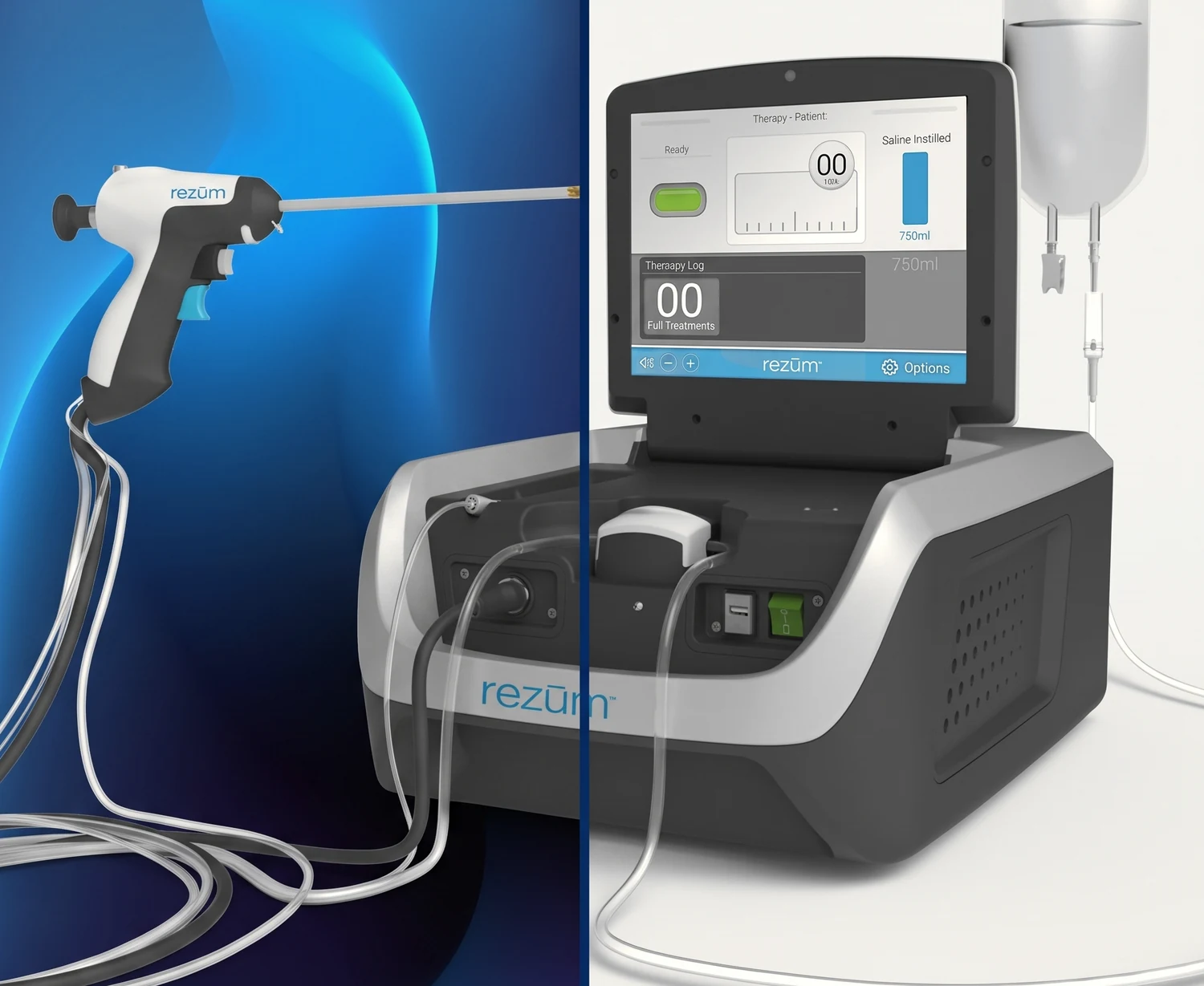
The Rezūm system: a hand-held delivery device with a slim rigid shaft on the left, and beside it the generator, a benchtop unit with a hinged touchscreen showing the treatment log and the volume of saline instilled, with a bag of sterile water hanging above it.
The whole of it. The generator boils sterile water and meters the vapour; the hand-held part is the only thing that goes anywhere near you, and only the last few centimetres of its shaft enter the prostate. Each injection lasts nine seconds, and the screen counts them. There is no laser, no electrical current and no cutting instrument in the room.
prostatic capsule cystoscope urethra steam condenses and releases heat at 70–80°C energy stops at the capsule cavernous nerves and the urinary sphincter run outside the capsule — untouched
Why steam preserves sexual function. The thermal energy is physically confined by the prostatic capsule. The nerves responsible for erections, and the sphincter responsible for continence, both lie outside that boundary.

No general anaesthetic needed

Performed under a local anaesthetic with sedation, avoiding the cardiovascular and respiratory risks of a general — which matters if you have other medical problems.

Sexual function preserved

Five-year trial data show no new erectile dysfunction, and dry orgasm in under 5% — against 75–90% after enucleation.

Genuine, durable relief

Roughly a 48% fall in symptom score and 44% improvement in flow, sustained across five years of follow-up.

It can treat a middle lobe

Unlike some minimally invasive implants, steam can be directed into a protruding median lobe — a common reason other options are ruled out.

02 · Is it right for you

Excellent for the right prostate. Not for every prostate.

Rezūm is recommended by NICE and works best in moderately enlarged glands, roughly 30 to 80 mL. Beyond that size it becomes less reliable, and an enucleation is usually the better answer. The assessment measures your gland rather than guessing at it.

The honest trade-off

Every option below relieves obstruction. They differ in what they cost you, and the two currencies are ejaculation and durability.

Rezūm against the alternatives
ProcedureGland sizeAnaestheticDry orgasmRetreatment
Rezūm30–80 mLLocal & sedationUnder 5%~4.4–8% at 5 yrs
Aquablation30–150 mLGeneralUnder 10%~1–4% at 5 yrs
HoLEPAny sizeSpinal & sedation75–90%Under 2% at 10 yrs
Bipolar TURP30–80 mLGeneral / spinal65–75%~10–15% at 10 yrs

What Rezūm costs you

Two things, and both are worth knowing before you choose it. Relief is not immediate — you go home with a catheter and improvement builds over weeks rather than arriving the day after surgery. And it is less durable than enucleation: roughly one man in fifteen to one in twelve needs a further procedure within five years, against fewer than one in fifty after HoLEP. If your priority is having one operation and never thinking about it again, HoLEP is the better fit. If preserving ejaculation matters more, Rezūm is.

Other options exist and are discussed at the assessment: Aquablation for larger glands where ejaculation still matters; UroLift, which uses implants rather than treating tissue but cannot be used where there is a median lobe; and TURP or HoLEP where durability is the priority.

03 · On the day

In and out, usually within a few hours.

  1. Anaesthetic. A local anaesthetic prostate block with sedation. You are awake but comfortable and drowsy, and no general anaesthetic is needed. The hospital will confirm the fasting rules that follow from it.
  2. Steam delivery. A slender telescope is passed along the urethra. A retractable needle is deployed into the obstructing tissue and sterile vapour injected in nine-second bursts, repositioned at roughly one-centimetre intervals. Depending on the size of the gland this means between four and ten injections.
  3. Catheter, then home. The treated tissue swells before it shrinks, so a catheter is placed before you leave to prevent you being unable to pass urine. The active part of the procedure takes five to fifteen minutes.

Fasting

  • Because you are having sedation: no solid food for six hours before admission, clear fluids up to two hours before, nothing in the final two hours
  • If purely local, the hospital may relax this — follow the instruction you are sent

Medication

  • Anticoagulants and antiplatelets: follow the specific instruction from your pre-assessment about when to pause them
  • Bring everything you take in its original packaging
  • You may be asked to continue an alpha-blocker for a few weeks afterwards while swelling settles

Getting home

  • Do not drive for at least 24 hours after sedation — your insurance will not cover you, and your reflexes are impaired whether or not you feel alert
  • Someone should collect you

What to wear

  • Loose trousers or tracksuit bottoms — you will go home with a catheter and a discreet leg bag strapped to your thigh or calf
  • No stiff belts or tight jeans

04 · Recovery

It gets worse before it gets better. That is the treatment working.

This is the single most important thing to understand about Rezūm, and the reason men lose faith in it around week three. The steam kills tissue, the body inflames as it clears that tissue, and the symptoms flare before the channel opens. Expect it, and it stops being alarming.

Days 1–7Catheter in place

Home with a leg bag

The catheter stays in for three to seven days while the initial swelling settles — longer if your prostate was large or you were retaining urine beforehand. Drink two to three litres a day. Rest, no heavy lifting, no strenuous activity. The full catheter guide is in the next section.

Day 3–7Trial without catheter

The catheter comes out

Removed painlessly in clinic. You stay until you have passed urine and a bladder scan confirms you are emptying. Worth knowing in advance: between one in ten and one in four men do not manage it at the first attempt and need the catheter back for a few more days. That is a delay, not a failure, and it is commoner in men who started with a large gland or a high residual volume.

Weeks 2–4The flare

Stinging, urgency, and blood

Symptoms often feel worse than before the procedure. Burning on passing urine, going frequently, sudden urgency, and blood in the urine or semen as treated tissue sloughs away. All expected. Two to three litres of water daily, avoid caffeine, alcohol and spicy food, and take simple painkillers regularly rather than waiting.

Weeks 2–6Turning the corner

The stream starts to improve

Most men notice a tangible change in flow from around two weeks, building steadily. The irritative symptoms settle over the same period.

Month 3Full benefit

Where you will end up

Maximum benefit is usually reached at around three months, once the body has finished resorbing the treated tissue and the channel is fully open. This is the point at which the result is judged, not before.

Managing the discomfort

Paracetamol regularly is usually enough. Anti-inflammatories help but can prolong bleeding, so take one only if your team has cleared it. Hydration is doing more work than any tablet: two to three litres a day keeps the urine dilute so that small clots do not form. Cut caffeine, alcohol, fizzy drinks and spicy food while the bladder is irritable, and avoid heavy lifting and cycling for the first few weeks.

05 · Managing your catheter

Going home with a catheter sounds worse than it is.

It is a soft flexible tube sitting in the bladder, held by a small internal balloon, draining continuously into a bag strapped to your thigh or calf under your trousers. Nobody will know it is there. Here is how to manage it.

Emptying the leg bag

Empty it when it is about half to three-quarters full. Letting it get heavy drags uncomfortably on the tube.

Wash your hands first

Warm water and soap, dried on a clean towel, before you touch the catheter or the bag. This is the single most effective thing you can do to avoid an infection.

Get into position

Stand over the toilet, or sit on the edge of the seat, and bring the valve at the bottom of the bag over the bowl.

Open the valve

Flip or slide the tap at the bottom of the bag to open, and let it drain completely. Try not to touch the tip of the valve with your fingers or let it touch the toilet.

Close it firmly, then dab it dry

Make sure the tap is fully closed and locked, then dab the end of the valve with clean tissue so stray drops do not mark your clothes. Wash your hands again.

Overnight

You will be given a larger night bag so you can sleep without getting up to empty the leg bag.

  • Do not disconnect the leg bag from the catheter. Push the night bag's connector into the outlet at the bottom of the leg bag instead — the system stays closed, which is what keeps infection out.
  • Open the leg bag tap once connected, so urine flows straight through into the night bag.
  • Hang the night bag on a stand beside the bed, always lower than your bladder. Never on the bed itself and never on the floor where the outlet can pick up dirt.
  • In the morning, close the leg bag tap, disconnect the night bag and empty it into the toilet. Follow your nurse's instruction on whether to dispose of it or reuse it — that depends on the type you are given.

Four rules that prevent most problems

  • Gravity does the work. The bag must always sit lower than your bladder. Do not rest it on your lap, and do not put your leg up above waist height — urine flowing back towards the bladder is how infections start.
  • Drink two to three litres a day. Dilute urine keeps the tube flushed and stops small clots blocking it. This matters more than anything else on this list.
  • Shower daily. Keep the leg bag strapped on, wash where the catheter enters with unperfumed soap and water, and pat dry. Never scrub or tug the tubing. No baths while the catheter is in.
  • Leave slack in the tubing. Straps snug but not tight enough to mark the skin, with enough give above the bag that it does not pull when you bend your knee or stand.

Bladder spasms and leaking around the tube

A sudden strong urge to pass urine, sometimes with a little urine escaping alongside the catheter, is common and usually just the bladder objecting to the tube. It is not a sign the catheter has failed and it does not mean it needs replacing. Keep drinking, and mention it at your appointment. If spasms are frequent and troublesome, medication can settle them.

06 · When to contact the clinic

Stinging and pink urine are normal. These are not.

Contact the clinic straight away, or go to your nearest A&E out of hours, if any of the following happens.

01 Nothing is draining, or you cannot pass urine

With the catheter in: if the bag has stayed empty for two to three hours and your lower abdomen feels painfully full, the tube may be blocked. Check first that it is not simply kinked under your clothing, then ring us.

After the catheter is out: being unable to pass urine at all is an emergency and needs to be dealt with the same day, not tomorrow.

02 Heavy bleeding

  • Urine that turns thick and dark red — the consistency of tomato soup
  • Bleeding that does not lighten after resting for an hour and drinking two or three large glasses of water
  • Large clots breaking up the flow

03 Signs of infection

  • A fever, or sudden shivering and chills
  • Urine that becomes cloudy, completely opaque or foul-smelling
  • Severe lower abdominal pain, or burning that worsens steadily rather than easing

Who to call

During clinic hours, ring 01865 307733.

The clinical team will assess your symptoms and tell you what to do next.

Out of hours, or if you cannot pass urine at all, do not wait. Go to your nearest Accident and Emergency department and tell the staff you have recently had Rezūm water vapour therapy to the prostate. WhatsApp and email are not monitored out of hours.

07 · Questions

The ones that come up every time.

Will it affect my erections or ejaculation?

This is the reason most men choose Rezūm, and the evidence supports it. Five-year data from the pivotal randomised trial show no new erectile dysfunction — because the steam is contained within the capsule and the nerves that produce erections run outside it. Men who arrive with good erections keep them; men who arrive with difficulties are not made worse.

Ejaculation is preserved in the great majority. Dry orgasm occurs in under 5%, against 75–90% after enucleation. A small number of men notice a modest reduction in the volume of ejaculate. If preserving forward ejaculation is your priority, this is the procedure that does it.

Why do I need a catheter if it is so minimally invasive?

Because the treatment works by causing controlled tissue death, and dying tissue swells before the body clears it. For a few days the prostate is temporarily bigger than it was when you walked in. Without a catheter a significant number of men would simply be unable to pass urine.

It is inconvenience rather than complication, it lasts three to seven days, and it is the price of an approach that does not cut anything.

How long before it works?

Most men notice their stream improving from around two weeks, with the full benefit at approximately three months. Nothing about the result should be judged before then.

The awkward part is weeks two to four, when symptoms often feel worse than before treatment — burning, urgency, frequency and blood, as the treated tissue sloughs. This is the treatment working, not failing.

Will I need it done again?

Possibly. Roughly 4.4% to 8% of men need a further procedure within five years — between one in twenty-two and one in twelve. That compares with under 2% at ten years after HoLEP.

That difference is the central trade-off. Rezūm protects your sexual function and asks less of you on the day; enucleation is more definitive and more likely to be a once-only operation. Neither answer is wrong, and which is right depends on what you are optimising for.

Is my prostate the right size?

Rezūm performs best in glands of roughly 30 to 80 mL. Larger than that and durability falls away, and an enucleation usually serves you better. The assessment measures your prostate on ultrasound or MRI rather than estimating it, and also looks for a protruding middle lobe — which Rezūm can treat, but which rules out some alternatives.

Can I have it if I take blood thinners?

Often yes, and you will be given a specific instruction at pre-assessment about whether and when to pause them. Do not stop anticoagulant or antiplatelet medication on your own initiative — the risk of stopping is sometimes greater than the risk of continuing, and that judgement is made case by case with your cardiologist where needed.

Is it approved for use in the UK?

Yes. The National Institute for Health and Care Excellence has assessed Rezūm and recommends it for men with moderate to severe lower urinary tract symptoms and a moderately enlarged prostate, concluding that it relieves symptoms, improves quality of life, preserves sexual function, and is cost-saving compared with more invasive surgery.

Taking the next step

The assessment decides this, not the brochure.

Symptom score, flow rate, residual volume, and the size and shape of your prostate — then a straight conversation about whether steam, waterjet, laser or resection fits what you want to protect. If Rezūm is not the right answer for your anatomy, I will tell you so.

WhatsApp is for appointments and practical questions. Please do not send clinical details or images through it.