Mr Musaab Yassin · Consultant Urological Surgeon
Surgery and minimally invasive treatments for urinary symptoms caused by benign prostate enlargement. Each row links to the matching patient leaflet from the British Association of Urological Surgeons (BAUS). Every one of these relieves obstruction. They differ in what they take from you to do it, how long the relief lasts, and which glands they are licensed for.
← Back to Oxford Men’s Health
Scroll sideways to see every column
| Illustration | Treatment | How it works | Anaesthetic & time | Catheter & stay | Urine leakage | Erectile function | Ejaculation | Needing it done again |
|---|---|---|---|---|---|---|---|---|
| Tissue-removing surgery — resection · enucleation · vaporisation | ||||||||
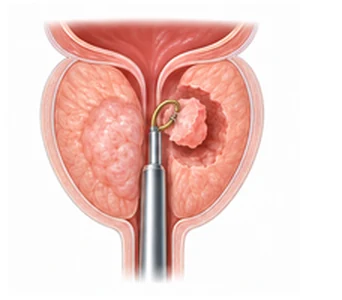 |
TURPMonopolar or bipolar30–80 mLBAUS leafletE23/109 | An electrical loop shaves the obstructing tissue away in chips, which are washed out at the end. | Spinal or general45–90 min | Catheter: 1–3 daysDay case to three nights | Temporary in up to 1 in 10. Lasting leakage well under 1%. | New ED 2–10% | Dry in 2 in 3 to 3 in 4 | 7.7% at 5 yearsBipolar 6.6% |
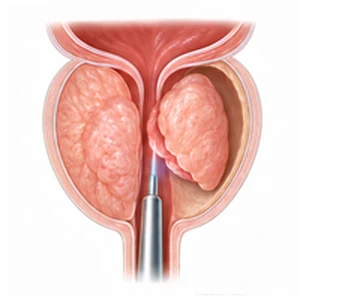 |
Laser enucleationHoLEP, ThuLEPAny sizeBAUS leafletE23/095 | The adenoma is separated from its capsule whole, pushed into the bladder and removed through the telescope. | Spinal with sedation in most cases; general where a spinal is unsuitable60–120+ min, size-dependent | Catheter: 1–3 daysDay case or one night | Early 6% at 3 months, 4–5% at 6–12. Beyond a year, 1–2%. | No significant change on validated scores | Dry in roughly 75–85% — expect it | HoLEP 6.6% at 5 yearsThuLEP 8.4% |
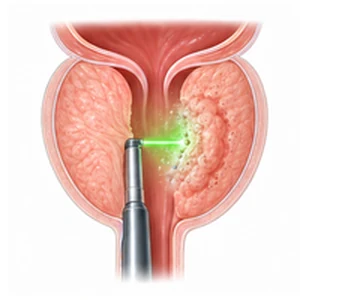 |
GreenLightVaporisation, 180 W30–80 mLBAUS leafletE23/190 | A side-firing laser vaporises the obstructing tissue rather than removing it for examination. | Spinal or general40–90 min | Catheter: 1–3 daysDay case or one night | Lasting leakage about 1% | No consistent increase over TURP | Dry ejaculation is common; published rates vary too widely to quote one | 7.1% at 5 yearsBeyond five years, about double HoLEP’s |
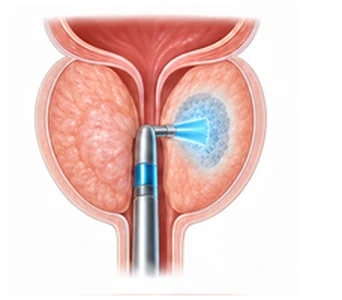 |
AquablationRobotic waterjet30–80 mL by EAU; trials to 150 mLBAUS leafletO25/190 | Ultrasound-guided planning, then a heat-free waterjet removes tissue to the plan. | General anaesthetic, always40–60 min in total | Catheter: 1–2 daysDay case to two nights | About 1% or less | No new ED in either arm of the 5-year randomised data | Dry in roughly 10–15% | About 4% at 5 yearsWATER and WATER II |
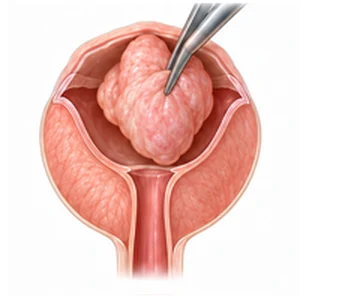 |
Simple prostatectomyOpen or roboticAbove 80 mLBAUS leaflet16/096 | The inner gland is removed through an incision; the outer capsule is left behind. | General90–240 min | Catheter: About a weekAround seven nights open; shorter robotic | 0.4–2% | New ED 2–10% | No semen at orgasm, in everyone | 4.4% at 5 yearsOpen series; no robotic equivalent |
| Other minimally invasive options — retraction · thermal · remodelling · embolisation | ||||||||
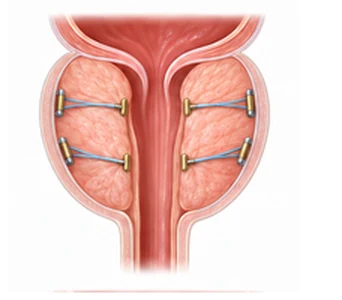 |
UroLiftProstatic urethral liftUnder 70 mL, no middle lobeBAUS leaflet21/179 | Permanent implants hold the lobes apart. Nothing is cut, heated or removed. | Local anaesthetic with sedation10–30 min | Catheter: Usually noneDay case | Temporary urgency about 4%. Lasting leakage is not a recognised risk. | No sustained new ED in the pivotal trial | Preserved | 13.6% at 5 yearsEAU advises this is higher than after TURP |
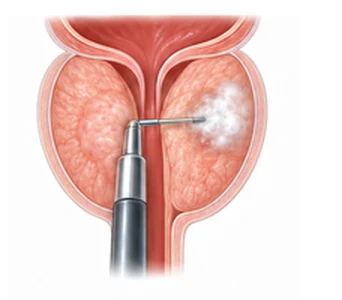 |
RezūmWater vapour therapy30–80 mLBAUS leaflet23/186 | Steam is injected into the obstructing tissue. The prostate shrinks over the following weeks. | Local anaesthetic with sedation10–20 min | Catheter: 3–7 daysDay case | Not a recognised risk; early urgency is common | None reported across five years | Preserved — bother scores improved | 4.4% at 5 years in the pivotal trialIndependent series report 5–11% |
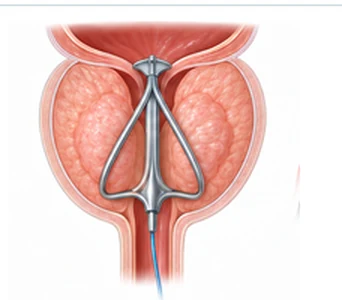 |
iTindTemporary nitinol deviceEvidence excludes above 75 mLNo BAUS leaflet | A three-strut frame reshapes the channel over five to seven days, then is removed. Nothing stays in. | Local anaesthetic with sedationBrief day-case insertion | Catheter: NoneRemoved at 5–7 days; two visits | Not reported in the key studies | No new ED reported | Preserved | 2.4% at 3 years in the original 81-man cohortAbout 11% to four years. Long-term data are thin. |
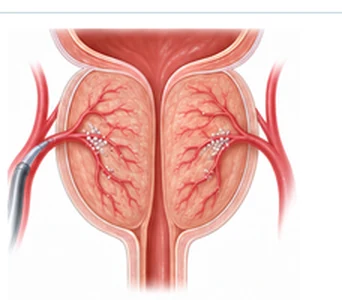 |
Artery embolisationPAENo guideline size rangeNo BAUS leaflet | An interventional radiologist blocks the prostatic arteries. The gland shrinks over three to six months. | Local anaesthetic with sedation60–180 min, via an artery | Catheter: Usually noneDay case or one night | Not a recognised risk | Preserved, slightly better than after TURP in the randomised comparison | Often preserved | 41.7% needed a TURP by five yearsThe only randomised comparison. Pooled series 20–26%. |
A balloon coated in paclitaxel is inflated inside the prostatic urethra. It splits the two lobes apart at the front, and the drug that transfers to the cut surface is meant to stop it healing closed again. No tissue is removed and nothing is left behind.
Two-year results in a hundred men are good — symptom score roughly halved, flow more than doubled, erectile scores improved, and 3% needing further surgery. But that is a hundred men at two years, against five-year randomised evidence for everything in the table above. NICE has no guidance on it for prostate enlargement and the 2026 EAU guideline still lists it as under investigation. A catheter is needed for at least two days, and about four in ten men see blood in the urine afterwards.
One distinction the manufacturer’s illustrations do not make obvious: there are two Optilume balloons. One opens a narrowing of the urethra itself — a stricture — and has NICE guidance behind it. The other, described here, splits the prostate open from the inside and does not. They are not the same operation for the same problem.