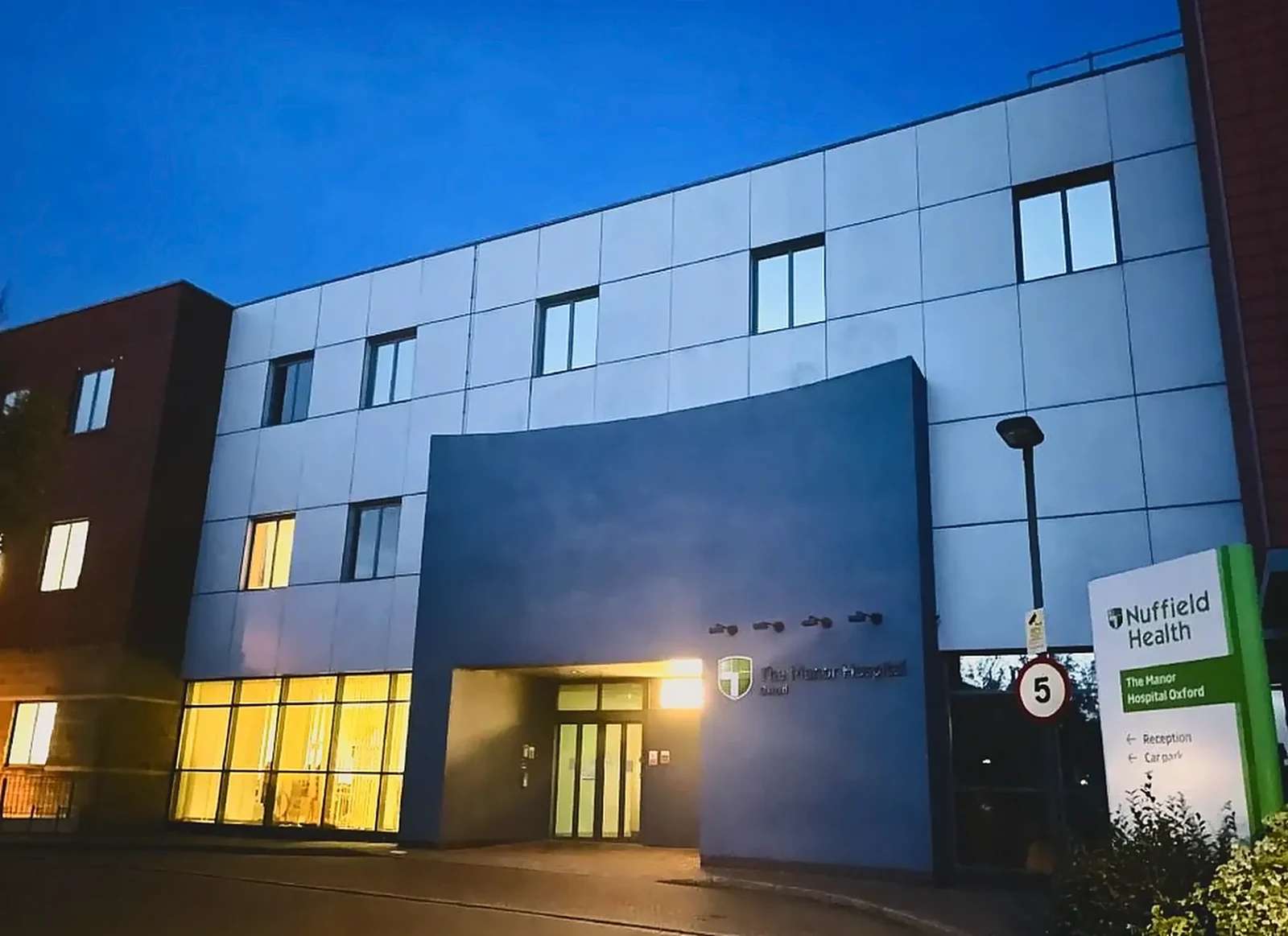
Nuffield Health The Manor Hospital, Oxford, at dusk. Nuffield Health The Manor Hospital, Oxford

Mr Musaab Yassin · Consultant Urological Surgeon & Andrologist

Oxford Aquablation Clinic

A complete guide to robotic waterjet ablation of the prostate — what it removes, what it protects, and where the evidence is strong and where it is not.

General anaesthetic Surgeon-planned, robot-executed Strongest evidence to 150 mL Ejaculation kept in most men

01 · Understanding Aquablation

A waterjet the surgeon plans and a robot executes.

No heat is used to cut, no incision is made in the skin, and the treatment is mapped on a live ultrasound picture before any tissue is removed.

The prostate sits underneath the bladder and surrounds the urethra, the tube through which urine leaves. As the inner part of the gland enlarges it compresses that tube, which is what produces a weak stream, hesitancy, stopping and starting, incomplete emptying, frequency, urgency and getting up at night.

Aquablation removes the prostate tissue causing that obstruction. It is performed entirely through the urethra, so there are no external surgical cuts.

What the machine does, and what I do

Three things are combined: real-time ultrasound imaging, computerised treatment planning, and a robotically controlled high-pressure saline jet.

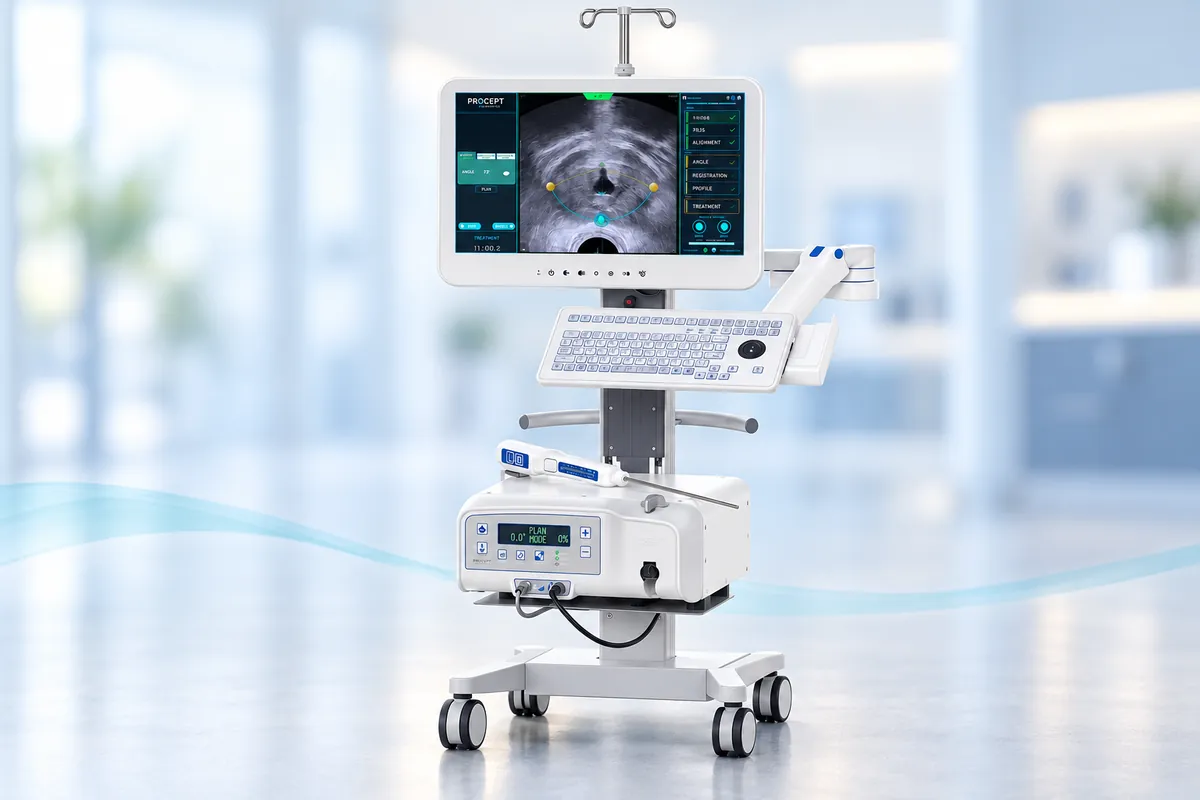
The AquaBeam robotic system: a wheeled console carrying a large planning screen showing a live ultrasound image of a prostate, a keyboard, and the handpiece resting on the pump unit below.
The system, as it stands in theatre. The screen carries the live ultrasound and the treatment plan; the pump below drives the saline; the handpiece on the right is the part that passes down the urethra. Nothing about it is cordless or office-sized — this is theatre equipment for a theatre operation. Manufacturer’s image · PROCEPT BioRobotics

An ultrasound probe gives a live image of your prostate. I then map out which areas should be removed and which structures should be left alone — with particular attention to the tissue around the structures involved in ejaculation. Once that plan is confirmed, the AquaBeam system directs a high-velocity jet of saline through the gland and executes it.

The robot performs the resection; the surgeon plans and controls the operation. That distinction matters, because the quality of the plan is where the judgement sits.

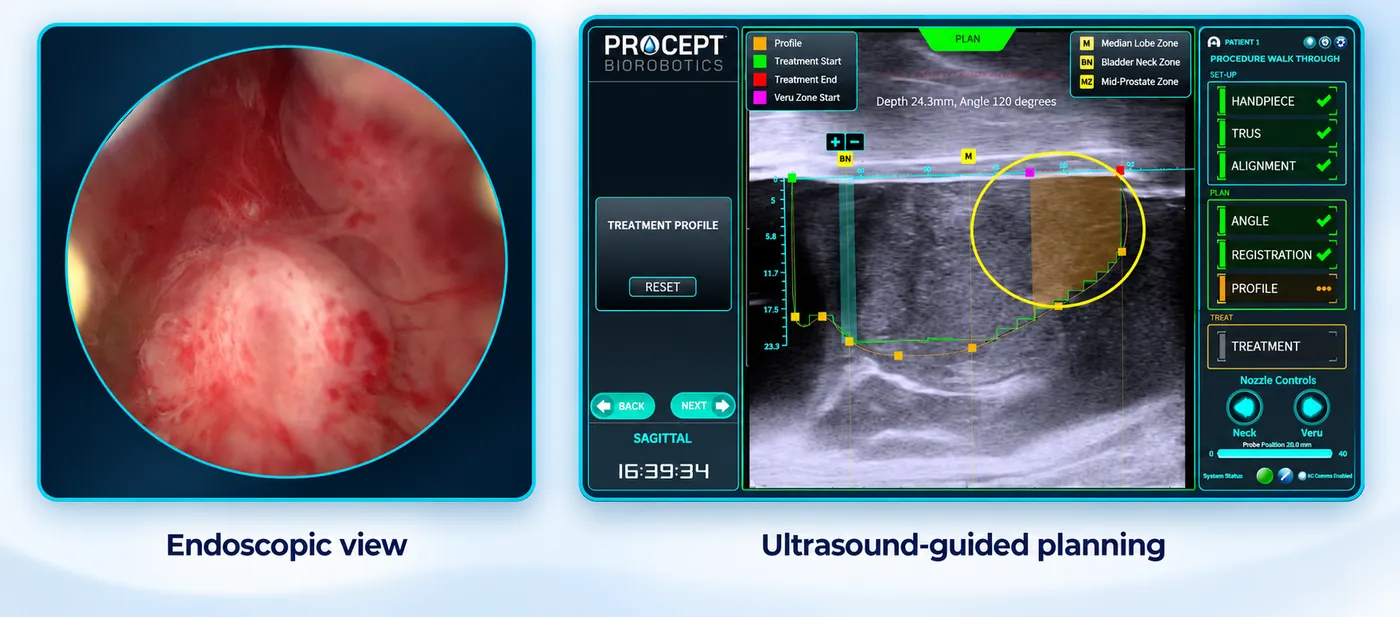
Two views side by side. Left, the endoscopic view down the telescope showing the inside of the prostatic urethra. Right, the planning screen: a sagittal ultrasound image of the prostate with the treatment contour drawn on it, depth and angle read-outs, and coloured markers for the treatment start and end and for the bladder neck, mid-prostate and veru zones.
What the planning actually looks like. On the left, the view down the telescope. On the right, the same gland on live ultrasound with the map drawn over it: the contour I set, the depth and angle, the start and end of treatment, and the marked zones at the bladder neck and around the veru that are deliberately left alone. This is the step that decides both how much obstruction is relieved and how likely ejaculation is to survive — and it is done before any tissue is removed. Manufacturer’s image · PROCEPT BioRobotics

One honest correction

The waterjet itself removes tissue without heat, and this is often described as a heat-free operation. It is not quite that. Electrical cautery is commonly used afterwards to seal bleeding vessels, so heat is used — just not to do the cutting.

Is it really “minimally invasive”?

The term is doing a lot of work in the marketing. Aquablation is minimally invasive in the sense that there is no skin incision, the operation is performed through the urethra, and the treatment is precisely planned using imaging.

But it is still a significant prostate operation. It is performed under a general anaesthetic, and involves removal of a meaningful volume of tissue, a catheter, a risk of bleeding, and a recovery period. It is better understood as an image-guided, robotically executed transurethral prostate operation than as a simple outpatient treatment.

02 · Is it right for you

The evidence is strongest in a particular range of gland sizes.

Not because larger prostates cannot be treated — they increasingly are — but because the follow-up thins out beyond a point, and you should know where that point is.

By prostate size

30–80 mL — the strongest comparative evidence. This is the range studied in the randomised WATER trial. Aquablation and TURP produced similar durable urinary improvement at five years, with better preservation of ejaculation after Aquablation.

80–150 mL — good prospective evidence. WATER II studied this range specifically. At five years, symptom score improved from 22.6 to 6.8, peak flow from 8.6 to 17.1 mL/second, and 96.3% remained free of another BPH procedure. That makes Aquablation unusual among ejaculation-preserving treatments, because there is real prospective evidence in genuinely large glands.

Above 150 mL — less certain. Aquablation is increasingly used above this size, and pooled analyses include glands from 20 to 242 mL. But the mature five-year prospective evidence extends to roughly 150 mL; beyond that it becomes increasingly observational. For very large prostates, size-independent procedures such as HoLEP remain important alternatives to discuss rather than dismiss.

If you have a median lobe

A median lobe is prostate tissue growing upwards into the bladder, and it makes some BPH procedures technically harder. Aquablation appears to cope with it well. An individual-patient-data meta-analysis pooled 425 men from four prospective studies, with glands from 20 to 150 mL, and found substantial improvement regardless of whether there was an obstructing median lobe. Only 0.7% needed surgical retreatment for recurrent symptoms during the first year.

A median lobe is not, by itself, a reason to rule Aquablation out.

Worth considering when

  • Symptoms are moderate or severe and medication has not been enough
  • There is significant bladder-outlet obstruction, or recurrent retention
  • The gland is moderately or substantially enlarged
  • There is a prominent median lobe
  • You want substantial tissue removed, not merely displaced
  • Preserving forward ejaculation matters a great deal to you

Another treatment may suit you better when

  • The prostate is exceptionally large
  • The longest-established durability evidence is your overriding priority
  • Maximum removal of the adenoma is the goal
  • Bleeding risk is a major concern
  • You want the least invasive option available, or to avoid an anaesthetic
  • Bladder function or anatomy points elsewhere

For some men that points to HoLEP. For others, to TURP, Rezūm, UroLift, GreenLight or prostate artery embolisation. Which operation is right depends on what you value most, and that is a conversation rather than a calculation.

03 · What it does to your symptoms

A large, fairly quick improvement — held to five years.

Tissue is physically removed during the operation, so the benefit does not depend on the gland gradually shrinking over months.

The most useful single analysis pooled 528 men from five prospective international studies. Average symptom score fell from 21.5 before treatment to 5.8 at six months and 6.6 at twelve. Peak urinary flow rose from 8.1 to 20.5 mL/second, and the urine left behind after passing water fell from 106 mL to 53 mL.

Symptom score

21.5 → 6.6 out of 35, at twelve months. On the standard scale, 0–7 is mild, 8–19 moderate and 20–35 severe — so this is severe to mild.

Peak urinary flow

8.1 → 20.5 mL/second. Flow roughly doubles in most series, though it depends on the bladder as much as the prostate.

Urine left behind

106 → 53 mL. Halved by twelve months — the bladder emptying properly again is often what men notice first.

A separate systematic review of seven studies and 551 patients found an average improvement of about 16.5 symptom points by three months, maintained through twelve. The authors also found considerable variation between studies, so 16 points is an average rather than a prediction for any one man.

How quickly

In WATER II, which studied glands between 80 and 150 mL, symptom score fell from 23.2 to 6.7 by three months, peak flow rose from 8.7 to 18.8 mL/second by six months, and residual urine fell from 131 to 47 mL.

Removing the obstruction is not the same as feeling fully recovered, though. The next section covers what the early weeks are actually like.

How long it lasts

In the randomised WATER trial at five years, symptom score had improved by 15.1 points after Aquablation and 13.2 after TURP — a difference that was not statistically significant, meaning both remained highly effective.

In WATER II at five years: symptom score 22.6 → 6.8, peak flow 8.6 → 17.1 mL/second, and 96.3% free of another BPH procedure. Comparing the two populations directly, 95% of the 30–80 mL group and 97% of the 80–150 mL group remained free of surgical retreatment at five years — retreatment rates of roughly 5% and 3%.

Two men who had it done

Figures describe a population; neither of these men is a population. Both had Aquablation under my care at Nuffield Health The Manor Hospital, and both agreed afterwards to be filmed by the hospital. Nobody from the practice was in the room, and neither film was scripted — which is the only reason they are worth watching.

Steve Clark Overcoming BPH
Overcoming BPH: Steve Clark’s journey. Filmed by Nuffield Health. Nothing is requested from YouTube until you press play.
Mark Oliver Finding relief
Finding relief: Mark Oliver’s BPH journey. Filmed by Nuffield Health. Nothing is requested from YouTube until you press play.

Five years is not a lifetime

These are genuinely reassuring numbers for a newer technology, and they are better than the evidence Aquablation had a few years ago. They are still not the same thing as the ten- and twenty-year record TURP and HoLEP carry. If durability over decades is your single overriding concern, that difference is real and you should weigh it.

04 · Ejaculation, erections and the trade-off

This is where Aquablation genuinely differs — and what it costs.

The advantage over conventional enucleation is real and repeatedly demonstrated. So is the price paid for it.

Conventional TURP and HoLEP frequently result in the loss of normal forward ejaculation. Aquablation was designed so the treatment can be mapped to avoid some of the tissue that matters for it.

A systematic review of 15 studies and 1,533 patients found preservation of forward ejaculation ranging from 72% to 99.6%. That range is wide for a reason: preservation is likely, not guaranteed, and it depends on your anatomy, the treatment plan, how much tissue has to come out, technique, and how each study defined ejaculatory dysfunction.

The strongest single piece of evidence is the randomised WATER trial. Procedure-related ejaculatory dysfunction occurred in 7% after Aquablation against 25% after TURP. A subgroup analysis of sexually active men with larger prostates found loss of ejaculation in 2% versus 41% — a striking figure, but a subgroup rather than the trial's primary outcome, so it deserves more caution than the headline number.

Against HoLEP

The gap looks larger still against conventional HoLEP, though the evidence here is weaker because the comparisons have not been randomised. A 2025 prospective multicentre study compared 75 Aquablation patients with 75 HoLEP patients. At six months both produced substantial improvement, with no statistically significant difference in symptom score or peak flow — but ejaculatory dysfunction was reported in 6.6% after Aquablation and 89.3% after HoLEP.

One study, 150 men, six months, not randomised. The exact percentages should not be assumed to apply universally. The direction, though, is not in doubt, and other observational comparisons point the same way.

What it costs: tissue

In that same comparison, prostate volume after surgery was approximately 47 mL after Aquablation against 18 mL after HoLEP, and PSA fell further after HoLEP. That is the trade in its clearest form.

HoLEP aims to shell out most of the enlarged internal gland. Aquablation removes tissue selectively under image guidance and deliberately leaves some behind where appropriate. That is precisely why ejaculation is preserved more often — and precisely why complete enucleation reports the lower long-term retreatment rates.

The same 150-man prospective comparison, at six months
AquablationHoLEP
Symptom score5.17.6
Peak flow23.8 mL/s28.6 mL/s
Prostate volume after47 mL18 mL
Ejaculatory dysfunction6.6%89.3%
Transfusion1.3%1.3%

Haemoglobin fell further on average after Aquablation in that study, although transfusion rates were identical.

Erections

The evidence is reassuring. The systematic review of 15 studies and 1,533 patients found erectile function remained stable across the included Aquablation studies, and earlier reviews reached the same conclusion.

The honest framing is this: there is no convincing evidence that Aquablation commonly causes erectile dysfunction, but erectile outcomes have been studied less extensively than urinary ones. Reassuring, on a smaller evidence base than the flow figures.
05 · Recovery, and the bleeding question

Bleeding is the thing to understand properly before you consent.

It is the most important safety consideration with Aquablation, and it is also the area where the evidence has changed most as the technique has matured.

The first few weeks

During the early healing period you may have urinary frequency, urgency, burning or stinging, blood in the urine, bladder spasms, temporary difficulty passing urine, or temporary leakage. All of these are recognised parts of the recovery rather than signs that something has gone wrong.

The bladder also needs time. It has been working against an obstruction for years, and clearing the obstruction in an afternoon does not immediately undo that. Urgency and night-time waking are usually the last symptoms to settle.

What the bleeding evidence actually says

The early large-gland experience was not reassuring. In the original WATER II study of prostates between 80 and 150 mL, bleeding requiring an intervention or transfusion occurred in 14 of 101 patients. That was early experience with large glands, and the technique used to control bleeding has changed considerably since.

Contemporary practice looks better. In the 2026 international ICARUS study, 1,946 men were compared with the original WATER populations. Among glands between 80 and 150 mL, transfusion was required in 1.3% in contemporary real-world practice against 5.9% in the original WATER II cohort.

A 2025 systematic review of 47 studies found most complications were minor — Clavien–Dindo grade 1 or 2 — with transfusion required in roughly 1–8%, the higher rates generally in larger glands and earlier series. Long-term problems such as urethral stricture or bladder-neck narrowing were uncommon.

Why I will not quote you 0.2%

A very large analysis of 70,270 procedures reports a combined transfusion-or-return-to-theatre rate of about 0.2%. It draws on a corporate database, manufacturer procedure counts and adverse-event surveillance, and databases of that kind can substantially underestimate complications compared with carefully monitored trials. It is useful evidence that serious bleeding is uncommon in current practice. It is not your personal risk, and I would rather give you the range than the flattering end of it.

A reasonable overall reading: bleeding remains a real consideration, particularly with large glands, but contemporary rates appear considerably lower than those reported while the technique was being developed.

06 · When to contact the clinic

Normal healing, and the four things that are not.

Mild stinging, sudden urgency and intermittent blood in the urine are all standard parts of healing. These four are different.

01 You cannot pass urine at all

This is an emergency. Bleeding inside the healing cavity can form clots that block the urethra completely.

  • You cannot pass urine at all
  • Severe or escalating pain and swelling low in the abdomen
  • A desperate urge to go with nothing coming out
  • Large, thick clots — bigger than a 50p coin — breaking up the flow

02 Heavy, unrelenting bleeding

Intermittent pink or red urine is expected. Heavy bleeding is not.

  • Urine that has turned thick and dark red — the consistency of tomato soup
  • Bleeding that does not begin to lighten after resting for an hour and drinking two or three large glasses of water

03 Signs of infection

The catheter and the procedure both raise the risk of a urinary infection slightly.

  • A fever, or sudden shivering and chills
  • Urine that becomes cloudy, completely opaque or foul-smelling
  • Burning that is getting steadily worse rather than slowly better

04 Severe pain

Mild pelvic aching is normal. Sharp or severe pain in the abdomen, pelvis or lower back that paracetamol does not touch should be assessed by a doctor.

Who to call

Ring the ward number you were given on discharge. That is the first call, at any hour.

It is answered by the nursing coordinator, who has medical support behind them. The team troubleshoots most problems on the telephone and escalates to the consultant in charge whenever a situation is not straightforward. If you need to be seen rather than advised, that can generally be arranged at the Manor; occasionally a problem needs a different specialty, and that is arranged through another hospital.

The practice office on 01865 307733 can be used during the day, but it is not the first port of call. Please do not use WhatsApp or email for anything urgent — they are not monitored out of hours.

If you cannot pass urine at all, or the problem is plainly more urgent than a telephone call, do not wait. Go to your nearest Accident and Emergency department and tell the staff you have recently had an Aquablation procedure.

On pain relief in the first weeks: paracetamol is the sensible first line. Anti-inflammatories such as ibuprofen add bleeding risk at exactly the point when the prostatic cavity is still healing, so anything beyond paracetamol is worth a conversation rather than a trip to the pharmacy.

07 · Questions

The ones that come up every time.

Answered from the published evidence, including the parts that do not flatter the procedure.

Will I still ejaculate normally?

Probably, and that is the main reason men choose Aquablation — but probably is not the same as certainly. Across 15 studies and 1,533 patients, forward ejaculation was preserved in 72% to 99.6%. The randomised trial against TURP found procedure-related ejaculatory dysfunction in 7% after Aquablation versus 25% after TURP.

Where it goes wrong, it is usually because anatomy or the amount of tissue that had to be removed did not allow the plan to spare what it aimed to spare. That is worth discussing before the operation rather than discovering afterwards.

Will it affect my erections?

There is no convincing evidence that Aquablation commonly causes erectile dysfunction. A systematic review of 15 studies and 1,533 patients found erectile function remained stable.

The caveat worth stating: erectile outcomes have been studied less extensively than urinary ones, so this is reassurance from a smaller evidence base rather than from the same weight of data behind the flow figures.

Is it as good as HoLEP at clearing the blockage?

Close on symptoms, behind on completeness. In a 150-man prospective comparison at six months there was no statistically significant difference in symptom score or peak flow — but prostate volume afterwards was about 47 mL following Aquablation against 18 mL following HoLEP, and PSA fell further after HoLEP.

A 2026 review put long-term retreatment after anatomical enucleation at roughly 1–2%, against roughly 3–8% at five years after Aquablation depending on the study and the definition used. More tissue out means less left to cause trouble later; it also means less tissue left to preserve ejaculation. There is no option that maximises both.

How much bleeding should I expect?

Some blood in the urine is expected and comes and goes during healing. Transfusion is the figure that matters, and it has fallen as the technique has matured: 5.9% in the original large-gland trial cohort against 1.3% in contemporary real-world practice for the same gland sizes. Across 47 studies the range is roughly 1–8%, higher in larger prostates.

Bleeding is the principal perioperative concern with Aquablation, and it is the main reason a large gland deserves a longer conversation than a small one.

Will it last, or will I need something else in ten years?

At five years, 95% of men with 30–80 mL glands and 97% with 80–150 mL glands remained free of another BPH operation. Those are good numbers.

What does not yet exist is the ten- and twenty-year evidence that TURP and HoLEP have. If you are in your fifties and want the operation with the longest proven record, that gap is a legitimate reason to choose differently. If you are weighing ejaculation against a difference in evidence maturity, that is a reasonable trade to make with your eyes open.

My prostate is very large. Can I still have it?

Up to about 150 mL, yes, and with good prospective five-year evidence behind it. WATER II studied exactly that range and found symptom score falling from 22.6 to 6.8 with 96.3% free of another procedure at five years.

Above 150 mL it is increasingly performed, but the evidence becomes observational rather than prospective. That is the point at which HoLEP — which is genuinely size-independent — deserves serious consideration, and I will say so if that is where your gland sits.

I have a median lobe. Does that rule it out?

No. An individual-patient-data meta-analysis of 425 men across four prospective studies found substantial improvement whether or not there was an obstructing median lobe, with only 0.7% needing surgical retreatment during the first year.

A median lobe makes some BPH procedures technically harder. On the evidence, Aquablation copes with it.

Do I have a choice about which operation I have?

Yes, and that is the point of setting the trade-offs out this plainly. Aquablation, HoLEP, TURP, Rezūm, UroLift and prostate artery embolisation all treat the same problem differently, and each buys something at the cost of something else.

The useful question is not which is best. It is which trade suits your gland size, your bladder, your bleeding risk and how much ejaculation matters to you. The Evidence Notes appraise each option in turn, including the case against it.

Where the figures come from

The numbers on this page are drawn from the full appraisal, Aquablation for BPH: what does the science actually show?, which cites seventeen sources in full — the WATER and WATER II trials, the pooled prospective analysis, the ICARUS real-world series, and the systematic reviews behind the ejaculation and complication figures.

Next

Whether this is the right operation is a conversation, not a calculation.

A first consultation is £295 and a follow-up £190. Anything beyond that is quoted in writing before it is arranged. You do not need a referral to book privately, and you are under no obligation to proceed with anything.